
Unlike George Town, Batu Kawan was—ostensibly—built “from scratch”. You live in one area, work or study in another, and hang out somewhere else. It sounds great in theory, but unless you have a car—which is not something to expect of students—getting around takes much more energy than expected.
Spearheaded by Arts-ED, a Penang-based arts and education non-profit, this participatory mapping project places local voices at the centre of heritage documentation—literally putting them on the map.
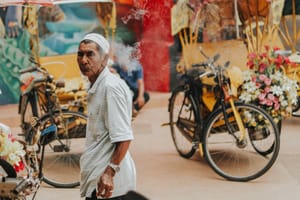
The majie may not have fitted the image of modernity, but she embodied its deeper transformations. Through financial independence, migration and lifelong labour, she was both breadwinner and caregiver, sustaining families across borders through decades of uncertainty, war and independence.
The office of Penang’s Executive Councillor for Tourism and Creative Economy (PETACE) has released data showing that the Penang International Airport (PIA) recorded a significant rise in foreign arrivals last year with a notable increase from China, Thailand and Taiwan.
Each day, the inhabitants of Penang, both in Seberang Perai and Penang Island, generate over 2,200 tonnes of waste, of which 80% is channelled via barges to the Pulau Burung sanitary landfill.
Determining the biological sex of early human remains is a critical step in reconstructing individual identities; sexual dimorphism in the skeleton can provide insights into the biology and social structures of ancient populations.
The mid-1970s to 1980s was a watershed moment as Malaysians began to enter the field of archaeology. Among the first few Malaysians who went overseas for postgraduate training and study were Zuraina Majid, the late Nik Hassan Shuhaimi, the late Adi Haji Taha, Leong Sau Heng and Ipoi Datan.
Prehistoric pottery in Malaysia is generally characterised by a range of surface treatments and vessel forms that reflect both utilitarian and cultural functions within early societies.