DISCUSSIONS OF PENANG’S heritage often centre upon historic buildings, cultural festivals and legacy businesses, reflecting a way of thinking about heritage in terms of visibility and marketability. But how does language sustain diversity in heritage within the rhythms of everyday life? The 2003 UNESCO Convention for the Safeguarding of Intangible Cultural Heritage recognises language as a primary vehicle of intangible heritage within the domain of oral tradition and expression. In the George Town UNESCO World Heritage Site, this role is immediately apparent. Multilingualism is not simply a reflection of demographic diversity in the inner city, but actively shapes, and is shaped by, the city and its people.
LANGUAGING IN GEORGE TOWN
A closer look at language practices in the inner city during the post-COVID-19 period reveals how multilingualism is lived, negotiated, and sustained amid ongoing urban change. It becomes clear that language is not simply present in the city, but is actively negotiated through urban life. Walking along Lebuh Pantai provides an illustrative linguistic experience. Bahasa Melayu and Hokkien emerge near the Weld Quay food court, then English, Mandarin and Bahasa Melayu as you pass Whiteaways Arcade. Approaching the Little India arch, Tamil is heard more prominently, before English and Bahasa Melayu resurface towards Lebuh Armenian and Lebuh Acheh. By the time you reach Sia Boey, Hokkien has settled back in. Languages shift across short distances, responding to space, activity, and social life. Their use is not uniform, but varies according to contexts, purposes, relationships and spatial conditions.
Even a single place holds multitudes. Visit Chowrasta Market in the daytime and you may find yourself moving between Hokkien, Cantonese, Bahasa Tanjong (George Town’s unique creolised Malay language), Tamil and English, all depending on where you are standing and the speakers present (for example, vendors, customers and vloggers). It is precisely this complex fluidity that makes the inner city so distinctively multilingual. English also operates as a bridging language across ethnic groups, while heritage languages (so-called “vernaculars” or “mother tongues”) are primarily sustained by intra-ethnic communication.
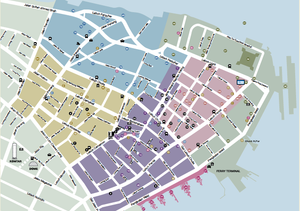
Social networks further reinforce these patterns. In familial, religious and workplace contexts, individuals embedded within dense community ties are likelier to maintain heritage language use in everyday interactions. Hokkien and Tamil are more present in informal, community-based settings such as religious spaces, markets and neighbourhoods, where repeated everyday exchange supports continuity. These tendencies are most visible in the inner city’s Business District and its Enterprise and Leisure Zones, while patterns in other enclaves are less pronounced, likely reflecting stronger commercial and external pressures.
Urban space also plays a critical role in shaping language practices within the inner city. Different environments create changing conditions for interaction, and therefore varying linguistic outcomes. Places that encourage open and diverse social contact tend to support multilingualism more robustly, while highly standardised or specialised environments may narrow the range of languages in active use. Curiously, Bahasa Melayu occupies a variable position despite its formal institution as the national language. In particular formal and institutional domains, such as some schools and workplaces, English functions as a shared medium. Bahasa Melayu is less consistently used in certain government-related contexts too, revealing a gap between language policy and everyday practice.
These observations neither emerged from a stable environment, nor do they currently exist in one. Across the inner city, various settings have steadily reshaped the conditions of everyday interaction. In spaces where vernacular languages once sculpted routine exchanges, newer commercial environments tend to favour more widely accessible languages like English, Mandarin and occasionally Bahasa Melayu. Open, permeable public spaces support interaction and linguistic diversity; enclosed, standardised ones tend to constrain both. Taken together, language practices emerge and evolve through ongoing negotiation, accommodation and lived experience in response to shifting urban conditions.
TAKING LANGUAGE SERIOUSLY
The shifting of streetscapes through gentrification has also transformed the resilience of heritage languages in the face of external pressures. Languages are not erased overnight, but the range of interactions—and therefore the speakers who keep heritage languages in everyday use—are quietly narrowed.
Efforts to sustain the visibility of George Town’s heritage are important, but they are, by nature, event-driven and intermittent. Language heritage, being embedded in repeated, unremarkable interactions, generate moments that carry cultural and social practice, but are often the hardest form of heritage to protect. Recognising language as a vital part of Penang’s heritage also means asking a harder question: are the conditions that support everyday multilingual life and heritage language use actually being sustained?
Here are some considerations across different levels of responsibility. At the level of site management, the linguistic environment should be treated as part of how heritage is assessed. At the level of urban planning, close attention should be paid to land use and tenancy mix. Overly specialised usage (for example, tourism or lifestyle consumption) tends to narrow the range of peoples and interactions within them. In contrast, mixed-use environments create the social density that keeps heritage languages in active use. At the level of cultural institutions, the presence of heritage languages in public-facing spaces should be taken seriously. Museums, galleries and audio-guided tours, for example, could also include widely spoken vernaculars like Hokkien and Tamil, positioned as equally central as Bahasa Melayu, English and Mandarin. Community-led programming, oral storytelling and inter-generational exchange deserve regular, substantive institutional support and funding to ensure their continued circulation.
Collaborations between government bodies, cultural organisations and non-governmental organisations could be strengthened by embedding heritage language maintenance in everyday institutions, including models such as community-based immersive education, multilingual public service provisions and structured partnerships between state agencies and civil society organisations. Such efforts could expand access to heritage languages beyond their immediate ethnic communities. They encourage broader linguistic participation and cross-cultural learning, while recognising and supporting the communities for whom these languages are a core part of cultural identity.
What might some examples look like? The “Speak Hokkien Campaign” is an example of on-site initiatives to reestablish and expand the use of Hokkien. On the digital front, the Ceritalah mobile application similarly bridges this gap, offering domestic and international tourists a way to learn and engage with local languages.
LANGUAGE AS A REPOSITORY OF LIVING HERITAGE
There is a question worth sitting with, as Penang continues to build an identity around its heritage status: what exactly is being conserved? If the languages animating this city are slowly edged out by the conditions that a certain metric of success creates, what remains is a city that looks like itself without quite being itself anymore. There is a need to shift our focus away from merely preserving form, to sustaining how the city is actually lived and experienced.
George Town’s UNESCO status was granted in recognition of its cultural diversity embodied in living and built heritage. The word “living” is doing a great deal of work here. A city that speaks many languages is not simply one with an interesting history. It is still engaged in the act of making meaning: still arguing, joking, bargaining, praying and loving in the languages it inherited. This, too, deserves to be celebrated and protected.
*Note: I acknowledge the Ministry of Higher Education’s support through the Fundamental Research Grant Scheme (project code: FRGS/1/2019/SSI01/USM/02/2). These observations draw upon systematic fieldwork conducted as part of a 2021–22 study and subsequent informal site visits.