
“WHAT SHOULD WE eat once we arrive in Penang?”
Every Penangite has fielded this question, and their response is always a list delivered with conviction. But lists signal more than personal preferences alone. They also identify brands so deeply embedded in Penang’s collective identity that to miss them means not really experiencing Penang at all. The question worth asking is not which brands make the list, but how they get there, and what they do to stay.
Three branding principles from Penang’s time-tested institutions provide universal take-home lessons for aspiring and established businesses alike.
EXPERIENCE COMPLETES THE PRODUCT
There is a persistent belief among business owners that if their products are good enough, then everything else follows. But heritage brands demonstrate that what customers remember, return for and tell others about is rarely the product alone, but also the experience it comes packaged in.
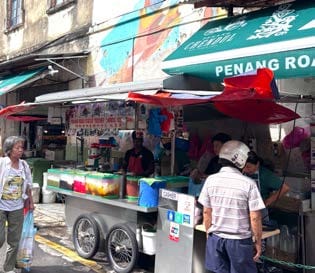
Penang Road Famous Teochew Chendul was founded in 1936 by Tan Teik Fuang, a Chinese migrant who pivoted from lock-smithing to desserts after recognising that Penang’s heat demanded ice-cold refreshment. [1] His stall has remained at its original location along Lebuh Keng Kwee, off Jalan Penang, for almost 90 years, but has since expanded into a nationwide franchise. Yet any Penangite will still describe the original location, with its long queues and Chendul that barely survives the hot journey from stall to table. The owners could have moved indoors, where air-conditioning is available, but did not. Whether instinctively or by design, the outdoor setting, with its controlled chaos, became part of the product rather than an inconvenience to access.
Ghee Hiang, founded in 1856 and widely regarded as one of Penang’s oldest brands, offers a parallel lesson. Its Tau Sar Pneah recipe has not changed, while its logo has remained the same since 1926. When the brand renovated its Lebuh Pantai outlet, the design direction deliberately evoked a late-19th-century Straits Settlement shophouse. Step inside, and the environment communicates the brand’s story before you purchase a single item. As executive director Ch’ng Huck Theng once said: “Some things have to evolve and some things have to stay.” What stays is the experience of purchasing the product, and what evolves are the channels of communication. Customers do not post photographs of Tau Sar Pneah on a plate, but share their trip to Ghee Hiang with others.
The lesson here is not to manufacture queues or simulate heritage. It is to be deliberate about every touchpoint—from physical space to packaging, from waiting in line to the moment of handover. Experience is not what happens after a product is sold, but emerges around and is designed alongside the product.
NON-NEGOTIABLES DEFINE THE BRAND
Every enduring brand has a set of principles that it will not abandon, where values are so closely tied to identity that any compromise renders the brand unrecognisable. These are not mission statements in annual reports, but the decisions that brands repeatedly make under commercial pressure. They signal exactly who the brand is, and whom it is for.
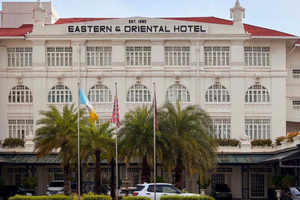
The Eastern & Oriental (E&O) Hotel provides the clearest illustration of this principle. Founded in 1885 by the Sarkies brothers, luminaries such as Rudyard Kipling, Somerset Maugham and Charlie Chaplin have stayed within its walls. In a 2019 press release, the E&O’s management explicitly insisted upon some details when the property underwent renovation. The Java tree would stay. The manual lift would stay. The dome and cannons would stay. These were not merely aesthetic choices, but defining acts of brand-consolidation.[2] The press release was also a declaration that some things were not available for commercial negotiation. Today, stays in the Heritage Wing begin at RM1,286 per night. The price of entry is itself non-negotiable, signalling that the E&O is not competing in terms of accessibility. Rather, it is delivering an experience so exclusive that only a particular kind of guest would seek it out. This clarity of positioning is precisely what has kept the E&O relevant for over 140 years.
Then there is Him Heang, established in 1948 and still operating from a single outlet on Jalan Burma. It has no agents, satellite stores or franchisees in an era when scalability is treated as the primary marker of business success. But Him Heang’s refusal to expand is itself a brand strategy, where scarcity is non-negotiable. Rather than a limitation, it is the brand’s selling point. This then begs the question of what a business should refuse to change. The answer to this question may lead to the beginning of a distinct brand identity.
THE COMMUNITY BECOMES THE BRAND
Penang’s most durable brands share a common characteristic. At a certain point in their history, they stopped being just businesses, and actually became part of their community’s identity, which then carried the brand forward without being asked, paid, or even aware that it was doing this at all.
Hameediyah Restaurant has occupied the same address on Lebuh Campbell since 1907, when its founder, Mohamed Thamby Rawther, a spice trader from Tamil Nadu, began selling Nasi Kandar, hawking rice and curries balanced on a shoulder pole to dock workers at Weld Quay. But what sustained Hameediyah across seven generations is not just the family’s commitment to the craft or a century’s worth of unchanged recipes. It is the community of customers who keep coming back, bringing others with them. A long trail of customers is a common sight outside Hameediyah, both on ordinary days and during peak seasons. Every person in the queue is also an advertisement that no agency can design.
Even Penang’s schools operate similarly, in their reliance on alumni networks for longevity. St Xavier’s Institution (est. 1852) was bombed at the end of the Japanese Occupation but was then rebuilt, while Chung Ling High School (est. 1917) remains Southeast Asia’s oldest surviving Chinese high school. These institutions did not build alumni networks as a retention strategy. Rather, such networks emerged because a shared schooling experience became a permanent part of how former students identified themselves. For example, when a former Xavierian introduces themselves at a business event, their school is part of that introduction.
WHAT CAN GROWING BRANDS LEARN?
None of the businesses examined here set out to become heritage brands. They set out to achieve more quotidian goals: to serve customers, hold themselves to particular standards and survive year-on-year. Their heritage was a by-product of their brands’ consistency, clarity and community.
Mei Tan is a second-generation leader of Asia Green Group and co-founder of Innovatif Plus, a platform built to help next-generation family business leaders carry their legacies forward. She described how these leaders did not fear failure, but welcomed change. “If we don’t innovate, the whole ship is going to sink.” Her answer to this challenge is the same one that many of Penang’s heritage brands have instinctively arrived at: keep values, change methods.
“We are the same brand, but better,” remarked Mei. A brand’s identity is not merely what a founder built. It is why they built it, and whether subsequent generations understand the distinction well enough to honour its legacy. This is a lesson that emerging brands can learn too.
ENDNOTES
- Hakem Hassan. (2023). “How Penang Chendul started as a roadside stall 87 yrs ago & grew to 30 outlets in M’sia.” Vulcan Post.
2. E&O Hotel. (2019). “History Lives on at E&O Hotel” (press release).