
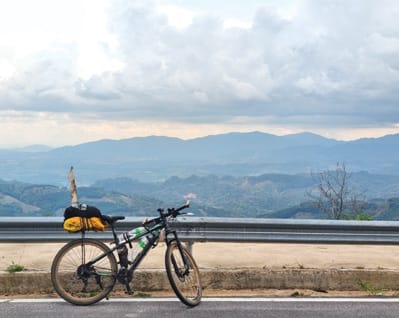
FOR YEARS, I have cycled through much of what was once called “Indochina”—specifically Thailand, Laos, Vietnam and Cambodia—and China, watching landscapes changing with every turn of the wheel.[1] But why choose a bicycle when flying, taking a bus or riding a motorbike would be faster and easier? I have tried all of these modes, and even travelled on foot. Yet cycling remains unmatched because of how a bicycle moves at a perfect pace. It is fast enough to carry you forward, yet slow enough to restore a rare, immersive presence. By shifting the traveller’s focus to connection and participation, cycling becomes one of the most sustainable ways of exploring the world, in an era where travel often prioritises efficiency and consumption.
ON LINGERING
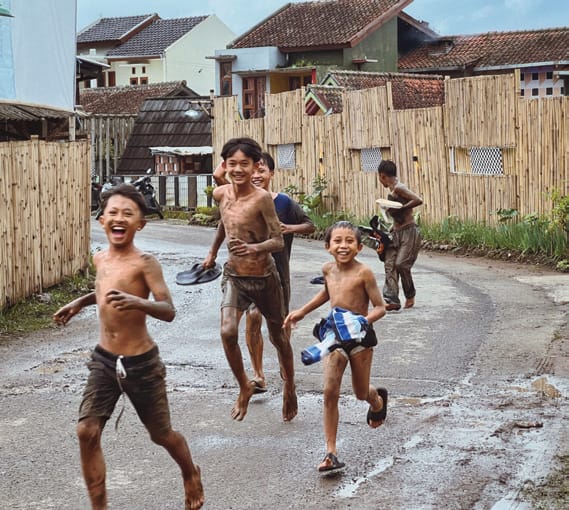
On a recent journey towards China, I lingered in Mae Salong, a small village in northern Thailand. But what was meant to be a short stop became more than a week’s stay. Each day, I navigated its narrow lanes on my bicycle, moving slowly enough to notice daily life unfolding: from women carrying baskets of vegetables to children playing in the streets, smoke rising from kitchen chimneys and dogs stretching lazily in the sun. Had I been on a motorbike, these moments would have slipped past unnoticed. Cycling allowed me to observe unobtrusively, to exist within the village rather than merely pass through it. Sustainable travel, I have learned, begins with slowing down.
One of the greatest advantages of cycling is the freedom to stop whenever curiosity calls. When driving a car, stopping can be inconvenient or disruptive. A motorbike offers flexibility, but is often detached from the feeling offered by a bicycle, where making effort becomes part of the experience of place. There is a deep satisfaction in climbing a mountain under your own power, to be rewarded by an open view. Physical engagement fosters respect for the environment. Not only does it leave minimal environmental impact while offering maximum sensory reward, but it also reminds you of the energy required to move through space: even those spaces closed to most forms of transport. In Dali, China, a 40km stretch along Erhai Lake is reserved almost entirely for pedestrians and cyclists. While electric bikes are permitted, their limited range makes long journeys impractical. But on a bicycle, I could follow the shoreline at my own pace, feeling the breeze, watching light shimmer on water, seeing mountains emerge and fade with each turn.