

BEYOND BOOKS AND EXAMINATIONS
PFS (est. 1816) is Southeast Asia’s oldest English-medium school. Its heritage makes it a particularly compelling place to study Literature today. Over 40,000 students sit for the STPM annually, but Literature attracts only a small number of candidates. Inside the classroom, students debate character motivations, annotate poems line by line and argue over interpretations that re-sist a single correct answer. When I asked a classmate taking Accounting (who often wandered into our classroom whenever his own teacher was absent) what he thought of the subject, his answer was unexpectedly enthusiastic. “English Literature is pretty lit. If I had the time to study it, I definitely would have picked it. Besides, writing any-thing in general shows creativity and it's much more exciting because it’s your sig-nature.”
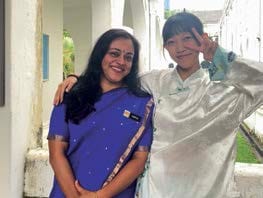
A poem can invite a conversation about family expectations, while a short story opens discussions of grief, identity or belonging. For me, that shift became deeply personal when I presented on KS Maniam’s “Arriving,” a short story from the revised 2025 Semester 1 syllabus. Maniam’s exploration of identity and belonging reflected questions I had quietly been asking about home, family and an existence between different worlds. Literature stopped feeling like an examination subject and became a way of reading my own life.
Literature rarely asks students for one correct answer. Instead, it asks them to de-fend an interpretation with evidence, listen to competing readings and sometimes return to a passage because someone else has noticed something they missed. Learning becomes less about memorising information than about paying closer attention. Empathy is not taught through being told to care; it is practised through reading to understand perspectives different from our own.
Much of my appreciation for Literature began with my teacher, Suriya Kumari, who has taught the subject at PFS for more than two decades. Her lessons rarely stop at preparing students for examinations. A poem becomes a conversation about society, a character becomes a debate about morality, and a single, once-overlooked sentence redirects an entire discussion.
Reflecting on education today, she told me: “It is something artificially ingrained through drills and memorising. The pursuit of education should come naturally.” Her lessons reflect this philosophy. Students question each other’s interpretations, revisit passages and discover meaning together rather than receive it ready-made. For a subject offered by so few schools, teachers like Suriya do more than just teach a syllabus. They keep Literature visible for students who might otherwise never encounter it.
WHEN A SUBJECT HAS TO PROVE ITS WORTH
“What can you do with it?”
This not unreasonable question seems to follow almost every Literature student. Students today are expected to think about university admissions, careers and financial security long before they actually leave school. Parents understandably want reassurance that the subjects their children choose will lead somewhere tangible. But this practical question can start becoming a test of whether a subject deserves to exist at all. Literature is often asked to justify itself in ways that many other subjects are not. Science is associated with innovation. Business promises entrepreneurship. Technical and vocational subjects are linked to employability. Literature, meanwhile, is frequently treated as something that must defend its practicality before it is considered valuable.
To be sure, Literature develops skills that employers consistently ask for: stu-dents learn to write clearly, analyse evidence, construct arguments and interpret complex ideas. These abilities travel beyond the classroom and into journalism, law, education, communication and public policy. Yet reducing Literature to a list of transferable skills feels incomplete. Literary scholar Simon During argues that literary study cultivates judgment through close reading, interpretation and sustained attention to language and ideas.[1] In practice, this means noticing how a single word changes a sentence’s meaning, reconsidering first impressions and defending interpretations with evidence.
Mohamad Rashidi Mohd Pakri, who has served on the Majlis Peperiksaan Malaysia (Malaysian Examinations Council) Board for STPM Literature in English since 2022, believes the current syllabus is “comprehensive and suitable” when it comes to preparing students for university-level Literature and related English-language degree programmes. He also sees the critical skills that students develop as being relevant beyond examinations, including in today’s job market.
Literature thus prepares students for university and careers. But it also pre-pares them for something less measurable. Haavineesh Vengadasan, PFS’s current school captain, recalls turning to Rudyard Kipling’s “If” during his first few months in leadership. “The poem served as a guide to me, as captain of prefects,” he said. A prescribed poem had become something to live by, offering a different kind of value altogether.
WHAT HAPPENS AFTER STPM?
As teaching Literature in English becomes harder for some Form Six schools to sus-tain, this begets a question of access as much as advocacy. Where the subject is offered, and who gets the opportunity to study it, may also reflect wider differences in access to English-language education between urban and less urban areas. A student cannot choose a subject which they have never encountered. But opportunities to learn also exist outside the formal curriculum. Where schools can no longer sustain full classes, other points of contact—such as reading clubs, creative writing circles, theatre productions and conversations around Malaysian literature—can still help keep the discipline visible.
By making the familiar strange and the unfamiliar recognisable, literature teaches us that “life is possible, living is possible!” as Suriya often reminds her students. It gives language to experiences we have felt, but never quite known how to articulate. I have been fortunate to study a subject that many students across Malaysia may never encounter. That is why this conversation is ultimately about opportunity, rather than insisting that every student should take the subject. Literature does not need to be rescued as a museum piece, but needs to remain accessible as a living part of our education.
Perhaps “why choose Literature?” is a reductive question. Perhaps the more important question is to ask why we have become so comfortable with asking this subject to justify its existence before making room for it in our classrooms.
ENDNOTE
- During S. (2015). When Literary Criticism Mattered. In R. McDonald (ed.), The Values of Literary Studies (pp. 120–36). Cambridge UP.