
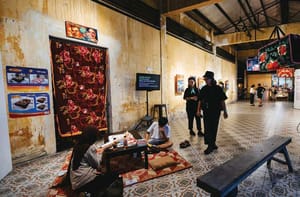
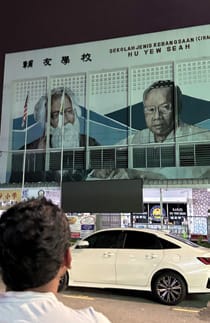
NIGHT: At the Hu Yew Seah school, a mural featuring the polymath Rabindranath Tag-ore, who laid its foundation stone, magisterially overlooks Lorong Madras. Often remembered as a global “Indian” intellectual, Tagore’s literary fame earned him a Nobel Prize for literature and a platform to articulate socio-political critique. Visiting George Town in 1927, he railed against the emergence of nationalism, which increasingly defined British India’s anticolonial movement. In Penang-based artist Hoo Fan Chon’s work, Tagore’s sojourn offers a starting point to centre the transnational trajectories of migrant workers from present-day Bangladesh. Penang Monthly speaks to Hoo about his solo exhibition—How Long Have You Been Here?—and the ethos of his cultural work. Its title, a com-mon query among migrant workers, now poses questions of migration, aspiration and performance.
OVERTURNING THE CANON
Almost a century ago, Tagore’s lecture series, given during a tour of Southeast Asia which culminated in Bali, articulated his increasing wariness of nationalism.[1] But in the years following his death, the Indian subcontinent was fractured by parti-tions, giving rise to multiple states, including India, Pakistan and Bangladesh.[2] Akin to Shakespeare’s institution as the canonical “English” writer, emergent national imperatives have assembled Tag-ore as the quintessential “Indian” writer. Yet this is artifice. Tagore’s ancestral home in Shilaidaha lies in Bangladesh, not India’s West Bengal border state, while his song “Amar Sonar Bangla” has been adopted as the young country’s national anthem.
