
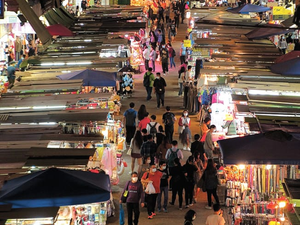
THE PASAR MALAM is often associated with affordability. Yet its economic value transcends consumer prices. By bringing ready-to-eat food into residential areas, night markets reduce the time and effort required by individuals to obtain dinner, while providing traders with access to customers without the financial commitment of operating permanent retail premises. These benefits are closely connected: customers gain convenience and variety, while traders gain
a comparatively accessible space for earning income. However, the continuity of this relationship depends on an increasingly difficult question. Can night market food remain affordable to customers while generating viable income for sellers?
THE ECONOMIC VALUE OF CONVENIENCE
The importance of convenient food options has grown alongside changes in the organ-isation of household life. Urbanisation, longer commuting times, greater female participation in the workforce and the prevalence of dual-income households have increased the value of time that might otherwise be spent on domestic work, for example, purchasing ingredients and preparing meals. In Malaysia, the share of household expenditure allocated to buying food away from home increased from 11.2% to 15.3% from 2019 to 2022.[1]
Purchasing ready-to-eat food is no longer necessarily an occasional activity; for many working households, it has become part of managing employment, travel and family responsibilities.
This broader shift in how households obtain meals is being accommodated by night markets. As places for consumption, they provide a practical alternative to home cooking, restaurant dining and food delivery. Night markets are widely expected to provide accessible food, particularly for households seeking a less expensive alternative to formal dining. Indeed, lower-income and vulnerable households rely disproportionately on night markets because of the accessibility of meals sold there.
The ability to make choices on limited budgets is also a key attraction. Customers can inspect what is being sold, compare prices across stalls and adjust decision-mak-ing according to individual budgets. A household does not have to agree on a sin-gle type of cuisine, while an individual can choose between having a full meal or sev-eral smaller items. This convenience is also experienced spatially. Unlike a permanent commercial centre which customers have to travel to, the night market temporarily brings commercial activity into or near residential neighbourhoods. Its value therefore includes price, time and travel savings.