
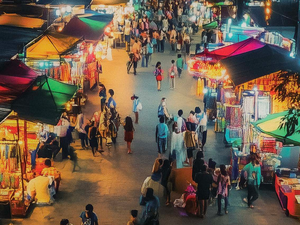
THE POLITICAL ECONOMY encompassing the night market is strangely illuminative of human society. Why do I say that?
Now, one can take the individual as the point of departure for analysing the bare constituents of society. Or one can start with the family, quickly scaling upwards to the clan, and so on.
The former approach leads to a Lockean individual giving up certain rights and freedoms, having realised that the resultant collective and polity bring more substantial gains than the retention of individual rights alone. The latter, on the other hand, is based on familial bonds, which require negotiations, agreements and intermarriages between different identities—whether based on surnames, clans or villages—for coexistence.
In either case, a political centre has to emerge. In general terms, how the nature of this centre is justified and extrapolated upon distinguishes the Western adoration for the Individual from the Confucian esteem for the Family. This difference is a much dis-cussed and debated matter which remains unsolved and unresolved.
This month’s focus on the night market (or “pasar malam” in Malay) inspires me to take an alternative point of departure for understanding human bonds—and bondage—across bloodlines, before the state emerged to absorb basic economic activities as the basis for its raison d’être.