THERE ARE SPACES we occupy by necessity—home, school, office—and others we gravitate to by choice. The latter are harder to define, yet equally essential. Urban theorists call these “third places”: realms beyond domesticity (first) and work (second), where social life unfolds in unpredictable ways.[1] They include the public, but extend beyond the formal. They shelter leisure and play; enable civic encounters; host subcultures and migrants; and allow boredom, resistance and intimacy.
A third place can be a park, a fun fair, a temple courtyard, a hawker centre, a gossip corner in a shopping mall or even just a bench in a transit hub, where strangers become characters in each other’s routines. Henri Lefebvre might call it lived space; Homi Bhabha would call it hybridity; Edward Soja names it third place—a site both real and imagined, the knowable and the unimaginable, everyday life and unending history, where new social arrangements emerge.[2]
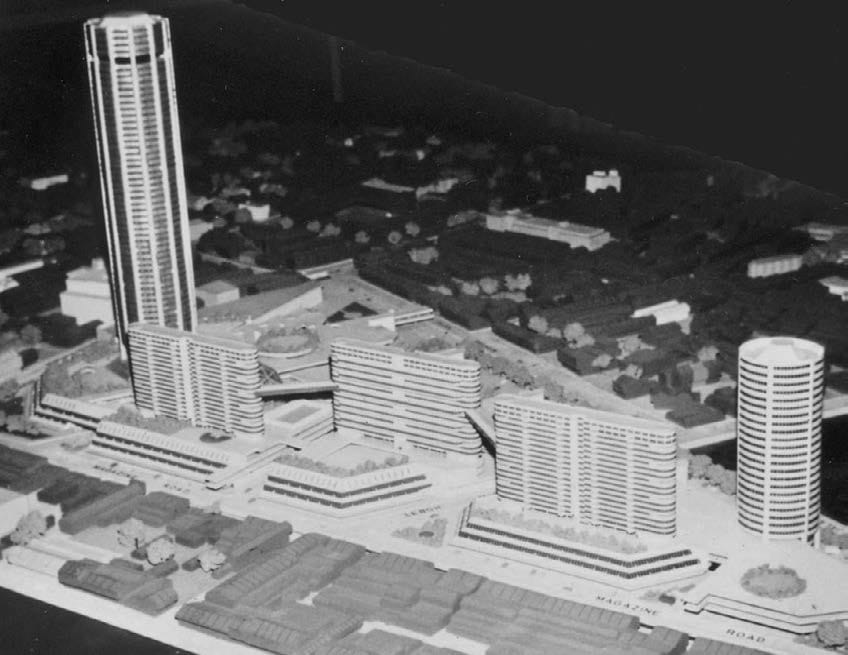
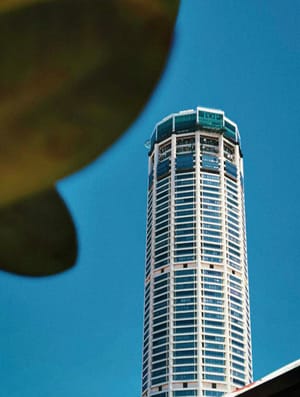
In a country like Malaysia that often operates through a utilitarian lens, has Penang’s technocratic governance—sometimes distant, sometimes deeply grounded—ever dabbled in spatial utopias? The existence of KOMTAR—officially known as Kompleks Tun Abdul Razak—suggests that it has. Conceived in 1970 as the Penang New Urban Centre, the infrastructure plan envisioned a whole new sociability: a multi-ethnic vertical city centre that would integrate government offices, telegraph and post services, a bus transporta-tion hub, a “Concourse Rendezvous”, a rooftop garden with a swimming pool, a multipurpose hall, an indoor hawker centre, cinemas embedded within the mall, and even residential flats designed for people across income and ethnic groups. These were avant-garde, modern, futuristic spaces and configurations that people at the time could hardly have imagined. It was a controlled heterotopia: a third place crafted through bureaucratic design, yet intended for the multitude. Whether that makes it genuinely a third place for the urban citizen or merely a totalising spatial system disguised as one remains an open question.