
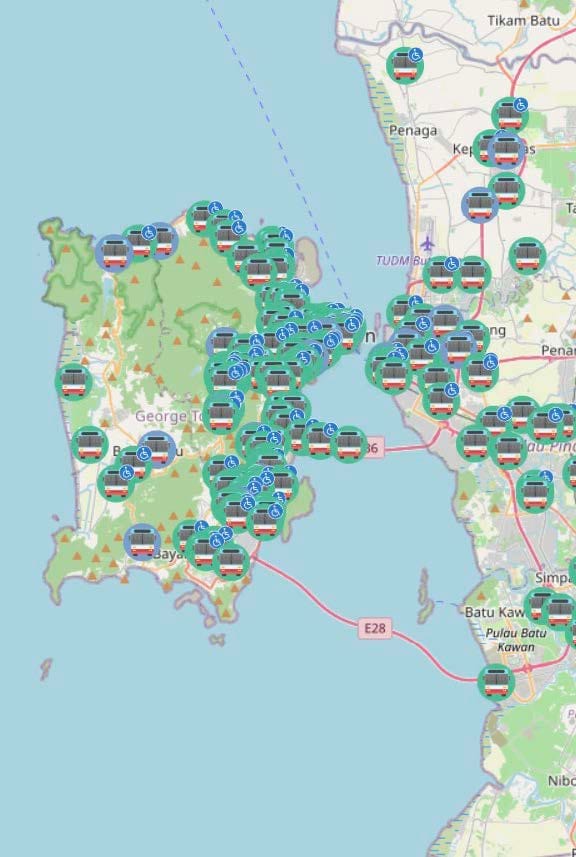
A BIRD’S-EYE VIEW of Penang’s public transportation network charts the real-time movements of all buses traversing the state, extending into Kedah
and Perak.[1] But for Rapid Penang’s approximately 49,460 daily users,[2] this overview is distant from the physical act of waiting patiently, if uncertainly, for their journeys to commence or conclude. Commutes are compounded by the geographical challenges posed by the island and mainland, seasonal surges in tourist numbers, as well as safety and logistical challenges involved in transporting a significant share of senior commuters. As the Mutiara Line Light Rail Transit (LRT) system proceeds towards expected completion in 2031, what do Penang’s public transportation prospects look like?
INFRASTRUCTURAL DREAMS, TECHNOLOGICAL MEANS
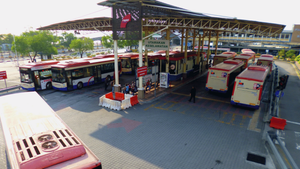
For ardent bus-spotters, there might be no better vantage point than KOMTAR. The buses cycling through the ground-floor terminal resolve into circular motions from the upper storeys, steadily dispersing island-wide. But as Zairil Khir Johari, Penang’s state EXCO for infrastructure, transport & digital, observes from the complex’s tower, greater increases in bus ridership are hampered by a lack of alternative public transportation options and the traffic challenges shared by all road users, compounded by limited room for expanding road and parking provisions.
This congestion is the root problem that the Penang Transport Master Plan (PTMP), a project that Zairil has been involved in since its inception 15 years earlier, aims to resolve. He sees the PTMP as a living document, forming the scaffolding for alternative transportation futures amidst funding, demographic and technologi-cal changes. It holistically integrates rideshare appli-cations, micromobility devices and demand-responsive transit, the “variables that contribute to restrategising and rethinking a different and new approach”. But the shape of a public transportation network is also dependent on funding. Now with federal financial support, the LRT promises to be a game-changer. Besides pro-viding an alternative commuting option, it enables pre-dictability, without which initiatives such as congestion pricing and pedestrianisation cannot work.
Until the LRT comes online, Penang’s authorities must optimise their current resources. Insufficient bus frequency and reliability can be addressed by bus lanes to some extent, as a trial along a 400m stretch from Jalan Penang (starting from Chowrasta Market) to the KOMTAR bus terminal showed. Peak-hour travel times fell and ridership increased significantly, despite initial resistance from local shopkeepers and non-compliance by some road users.[3] As City Council of Penang Island (MBPP) councillor Lee Seng Hwai noted, however, having fragmented bus lanes “is unlikely to yield significant efficiency gains.” The upcoming Mobility Management Study for Penang (expected completion end-2026), which includes bus routes in George Town and pedestrian connectivity along the LRT corridor, “will guide decisions on whether to expand, modify or
discontinue the trial bus lane initiative”.