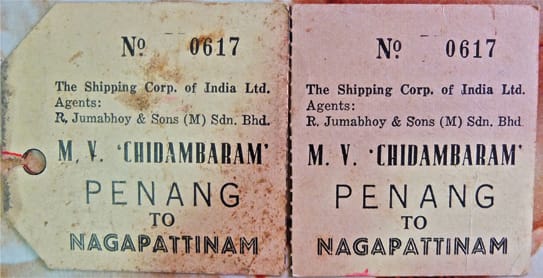
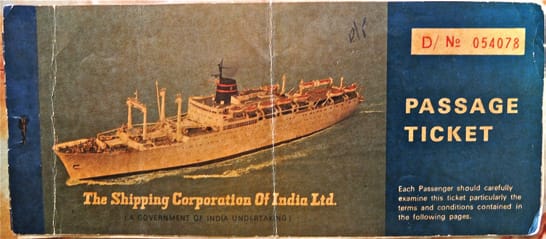
THERE ARE ELDERS among Penang’s Indian community who still remember the huge steamships that transported people and goods between India and the port of Penang, before commercial flights gained prominence. They fondly recall the names of famous passenger ships traversing the Indian Ocean and the Bay of Bengal: the Rajula, the Straits of Madras, the Jal Gopal and the Chidambaram. Each transported hundreds of people every 22 days, offloading them at George Town’s port before taking hundreds of others to India. Besides enabling the movement of people, who contributed to Penang’s vibrant cultural ethos, so too did products travel: spices and foodstuffs circulated through Penang, where many of the agents handling commodities operated in and around the enclave now known as “Little India.” Edibles like betel nut, copra, onion and nutmeg were spread out, like carpets, to dry in the sun along the sides of streets. However, such critical shipping activities receded after the complete removal of Penang’s free port status in the late 1960s. Brokerages and commissions linked to shipping dwindled away, and many older individuals, whose trades benefitted from the free port, soon left for India.
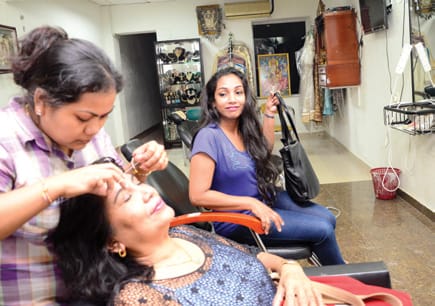
Today, some heritage advocates argue that Penang’s Malaysian Indian community is experiencing another form of disappearance, albeit less obvious, through the loss of traditional businesses and lifestyles, in the very zone marked for conservation. George Town’s joint inscription as a UNESCO World Heritage Site alongside Melaka resulted in a focus on preservation and conservation, not only of physical buildings and streetscapes, but also the living cultures of its various enclaves, including their festivals, cuisines, languages and ceremonies. However, tour-ism-related enterprises now dominate the Little India enclave, while traditional traders may be ejected or just fade away due to a combination of factors such as the exponential rise in rent and other operating costs, and the acute reduction in demand for their services. Are the community’s traditional trades and lifestyles experiencing a seismic change? If so, what are we to make of this shift?
THE INVENTION OF LITTLE INDIA
George Town’s multicultural living heritage originated from the trade routes link-
ing Great Britain and Europe to the Middle East, the Indian subcontinent, the Malay Archipelago and the Far East. “Both towns [George Town and Melaka] bear testimony to a living multi-cultural heritage and tradition of Asia, where the many religions and cultures met and coexisted,” runs the statement by UNESCO. “They reflect the coming together of cultural elements from the Malay Archipelago, India and China with those of Europe, to create a unique architecture, culture and townscape.”