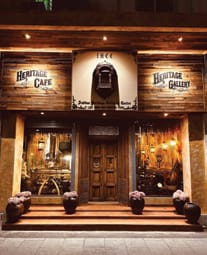
IF THE WALLS, windows and doors of Penang’s “Little India” could speak, they would tell countless stories about the place. From Padukara Theeru (Boatmen’s Street) and Elam Muchanti (Jalan Masjid Kapitan Keling), to Kadai Theeru (Street of Shops, or Lebuh Pasar) and Chetty Theeru,[1] each carries its own histories, memories and identities. And so, when the Indian Heritage Gallery & Cultural Centre (IHCC) opened its doors with pomp on 1 May, it was a momentous occasion. A gallery of this nature can be a cultural anchor, consolidating multicultural ties and cross-community kinship among Penangites and tourists alike.
FINDING HOME IN A HISTORIC ENCLAVE
Despite the presence of Little India, little of the community’s origins and cultural heritage is known to the public; the city still lacks a proper establishment to act as repository and intermediary showcas-ing the Indian community’s cultural iden-tity. True awareness and understanding require the availability and accessibility of GLAM infrastructure: that is, galleries, libraries, archives and museums.[2]
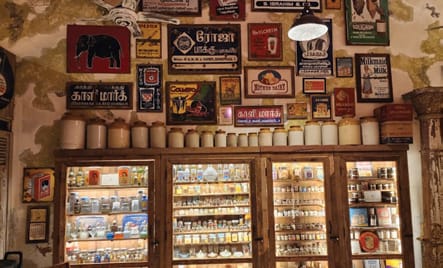
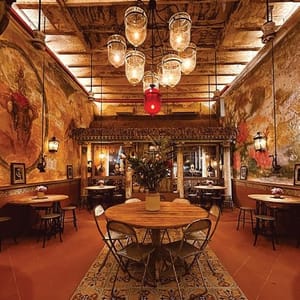
IHCC fills this gap, founded by three visionaries: N. Ramanathan AR A. Nachiappan (founder and cocollector); Adaikalaraja Packiam of Jayam Group (patron and strategic facilitator); and Mahadevan Gopal Rengarajan of Vintage Maha Museums (prime collector). Its story begins on Penang Street, where Ramanathan once ran the Colo-nial Chettiar Straits Museum. He met Mahadevan in Karaikudi, India, and was captivated by his collection. Mahadevan wanted to ship 14 containers of items over to Malaysia, far more than Ramanathan’s small space could ever hold. Their search for new premises led them to a building with a story of its own. It once housed Enrico’s Trading, a longstanding landmark for Pen-ang’s Indian community,[3] before being repurposed as a restaurant run by Adaika-laraja. But when the business began struggling, Adaikalaraja could not bring himself to let the building go: it held his earliest memories of Penang, beginning with the day he first arrived from India to the start of his working life here. This personal attachment was the building’s saving grace.
Rather than fading away, it found a new purpose as the IHCC’s home, now housing Ramanathan’s former museum’s collection.
IHCC is a key exemplar of the creative tourism model. Here, tourists do not just see, but are also provided with opportunities to learn, co-create and participate in Indian cultural processes and practices. This sense of cultural immersion was intentionally curated; the owners have also transformed the upper floor into a library and a space for disseminating Indian cultural practices (for example, saree-tying, floral arranging, playing traditional games).
An antique portable shrine made of Burma teak, set with rubies and containing a Than-javur painting of Lord Rama’s coronation (Ramar Pattabhishekam), serves as the welcoming artifact.[4] This key scene from the Ramayana shows Rama’s ascension to the throne. This shrine embodies the artistic traditions of Thanjavur District, which boasts strong historical bonds with Penang. Steamship routes once linked Nagapattinam and Madras with Penang, which was also the site of exile for the Maruthu Pandiyar brothers’ relatives and soldiers after the 1801–02 Polygar Wars. The forced labour of these exiles built early roads and landmarks like Fort Cornwallis.
The IHCC collection also highlights mid-19th to mid-20th century clockwork tinplate toys imported from Germany, Japan, the UK and the US. These intricate playthings reflect the immense wealth and prosperity generated by colonial Malaya’s tin-mining and plantation economy, which helped build consumer demand. Functional wooden tools such as ladles, spatulas and moulds, as well as antique Burma red-ware,[5] are on display. So too are stone hand-grinders, including components such as the ammi kal (grinding stone), attu kal (stone mortar and pestle), as well as the saddle and rotary querns designed to preserve the natural flavours and aromas of spices by minimising heat generation during grinding. Different types of thengai thuruvi (coconut scrapers/graters) are also present.
IMPACTS BEYOND ITS FOUR WALLS
The IHCC’s role and impact on George Town’s macro- and meso-level urban set-ting cannot be dismissed. Located along upper Beach Street, its proximity to, and interdependency with, Little India was intentionally orchestrated, according to Ramanathan. Visitors to Little India can drop by the gallery—which he envisions as complementing the enclave—to learn about the Indian community’s history. An “Indian Heritage Trail” of sorts will be curated in due course to link the gallery with other Indian establishments within Little India. Since the Lebuh Pasar and Lebuh Queen areas are predominantly commercial, the IHCC celebrates cultural heritage, going beyond merely showcasing Indian business activities.
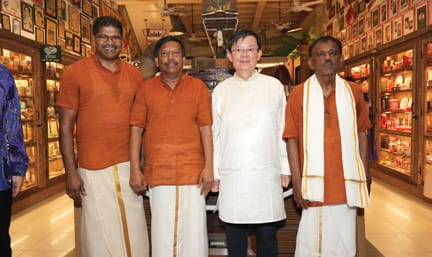
The gallery demonstrates how traditional shophouses can be adaptively reused within a network of diverse cultural and creative hubs, state entities such as Pen-ang State Museum and Penang State Art Gallery, and successful private initiatives (for example, Pinang Peranakan Mansion, ChinaHouse, Jetty 35). Mindful consideration went into teasing out the gallery’s cultural value proposition. As Ramanathan repeatedly stressed, it had a key goal: “Getting the youth interested to know and understand our Indian cultural heritage.” [6] Consequently, generous concession rates apply to student visitors. He aspires not merely to educate Indian youths, but also to make the wider community aware of Indian cultural heritage. As such, the gallery assumes a profound role as an inter-mediary for intergenerational, intercultural and intercommunity sustainability: during the opening ceremony, a group of 60 Chinese well-wishers came clad in sarees and dhotis.
IHCC is both tangible and intangible cultural heritage: the conservation of the physical building preserves George Town’s tangible heritage, while safeguarding intangible cultural heritage (for example, stories, memories, identities) within its walls.
*Note: Photographs courtesy of IHCC unless otherwise stated.
ENDNOTES
- A financial hub for the Nattukottai Chettiar community, which dominated the informal banking and money-lending business in colonial Penang.
- Generally, a museum is a permanent, non-profit institution dedicated to collecting, conserving, researching and educating the public about cultural and historical artifacts, while a gallery primarily exhibits artwork, often with a commercial or promotional focus.
- This fourth-generation family-run business traces its roots to the early 1900s, when M. Mooka Pillai, originally from south India, established a small trading business in George Town. His son, KS Nathan, joined the business in 1940 to continue the family enterprise.
- Thanjavur, in south India, was formerly known as Tanjore.
- An iron oxide-rich earthenware, decorated using the slip-trailing and sgraffito techniques.
- Khoo interviewed Ramanathan and Adaikalaraja at IHCC on 4 June.