HERE I AM on a cracked plastic stool in “Little India,” nursing a thick semi-sweet kopi susu while the humidity does its level best to drown me.
My T-shirt is already drenched—a lost cause by 10am—but the air here is surprisingly sweet. It is a clean, heavy blend of roasting coffee beans, fresh jasmine garlands and the sharp, medicinal sting of sandalwood incense, amidst the multicultural hum of the neighbourhood.
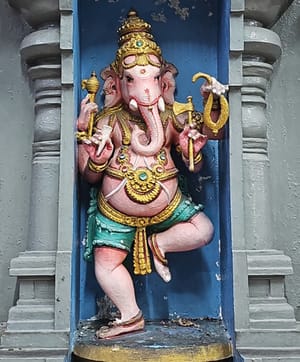
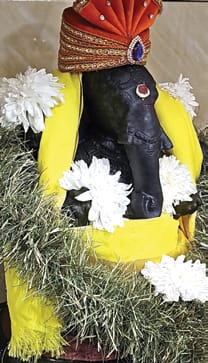
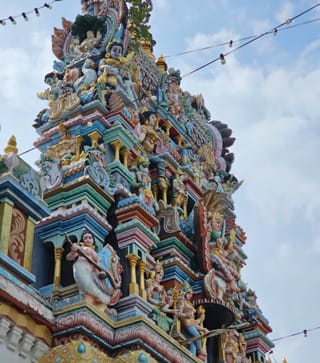
Across the street, at the footsteps of Sri Mahamariamman Temple, the oldest Hindu temple in Penang, a man is cracking a coconut open. A clean, violent break against the stone. Water spills over the sun-bleached pavement in a sacrificial washing of the slate. He is not talking to the big bosses yet. He is not looking for Shiva’s destructive fire or the goddess’s fierce, world-shaking protection. He is starting with the guy with the trunk. The big man, the cosmic bouncer: Ganesha himself.
In the chaotic, beautiful sprawl of the Hindu pantheon, one rule is absolutely non-negotiable: Ganesha goes first. For Hindus, life is a relentless minefield of obstacles, and Ganesha has the metal detector. He is the Vighnaharta, the Lord of Obstacles, but he does not just shift them aside like a polite valet. He owns them. He puts the boulder in your path when you are being self-important, and rolls it into the ditch when you have finally shown some genuine humility. In these ways, his presence encourages a humbler approach to life, grounded in the acknowledgement of your limits.
PRACTICAL WORSHIP
A Hindu shopkeeper does not dare start a business on Lebuh Chulia, their family does not move into a new shophouse on Lebuh Armenian and absolutely nobody sits down for a wedding feast without first acknowledging the elephant-headed deity guarding the threshold between “what is” and “what could be.” The tradition of Prathama Puja, the first worship, is not some accident of history. For Hindus, it is akin to a spiritual insurance policy. It is a necessary admission that no matter how smart you think you are, the universe can still trip you up on the way to the door.
Penang’s port was built on transitions, where people arrived with nothing but suitcases and prayers. When early settlers from South India stepped off the boats at Swettenham Pier, they were looking for a way through life, not abstract philosophy. They found it in the little red and yellow street-corner shrines you see everywhere in George Town, tucked between colonial pillars. There waits Ganesha, sitting in the humidity, smelling of fresh limes. He represents the Muladhara Chakra: the root, the base of the spine, the earth beneath your feet. You cannot reach for the heavens if your feet are stuck in the mud. By praying to him first, Hindus ground themselves before the chaos of the day begins.
NO SANITISED LORE
To understand the devotion to Ganesha, you have to understand a family tragedy with more spice and heart than most Shakespearean dramas. Parvati, the Divine Mother, just wanted a bath. She wanted some peace. So, she scraped together some clay from her own skin—literally creating life from her own grit—and breathed a son into existence to guard the door. Then came Shiva, the Destroyer, the husband who had been away on a long-term trip, “finding himself” in the mountains. Seeing this kid blocking his way, he did what any short-tempered deity would do: he decapitated him. When Parvati found out, she did not just cry, but threatened to unmake the entire universe. To fix the mess, Shiva grabbed the head of the first creature that he found facing north—an elephant—and brought the boy back to life. In a moment of divine damage control, he declared that Ganesha would forever be the first deity to be worshipped.
This is a story about ego, the clash between the old guard and the new, and, ultimately, about restoration. Everyone loses their head sometimes, and for Hindus, Ganesha is the patron saint of getting back up with a different perspective.
In aesthetic terms, Ganesha’s form is a masterclass in functional design. Those massive ears are not just for show; they are there to listen more, to hear the whispers of the universe and the cries of the suffering in a world that will not shut up. The small mouth suggests that we talk less and waste no breath on nonsense. His big belly digests everything—the good, the bad, the spicy, the bitter—consuming the world’s sorrows and turning them into peace. Then there is the broken tusk, which he snapped off to use as a pen to write the Mahabharata. It is a reminder of sacrifice for the sake of knowledge, where there is no real art with-out a little blood. Even his vehicle, a tiny mouse, is symbolic. It represents the ego: small, nibbling, greedy and always looking for a shortcut. Ganesha simply sits on it. He controls desire, and not the reverse.
THE HARD STONE OF REALITY
Back at the temple, another devotee whacks a coconut to the ground. During festivals like Vinayagar Chaturthi, the sheer volume of shattered shells is staggering. It is a brutal yet necessary metaphor. The hard outer shell represents the ego, that stubborn, defensive layer we build around ourselves to feel important. The white flesh inside is the soul, and the water is the sweetness of divinity. To get to the good stuff, you first have to be broken. You have to smash that ego against the hard stone of reality, which Ganesha holds. There is something deeply punk about this total rejection of the superficial.
Under the heavy, white heat of noon, it becomes clear that Ganesha is the perfect deity for a traveller like myself. In this glare, there are no shadows to hide in, no golden light to soften the rough edges of the road. Travel is a series of obstacles: delayed flights, missed connections, bad directions and language barriers. We are constantly at the mercy of the threshold. Hindus pray to him first because they have to be humble enough to admit that they do not know the way through the midday haze. They must admit that the road ahead is uncertain, and that they need a guide who is not afraid of a little heavy lifting.
So, whether you are Hindu or otherwise, do not just walk past that elephant-headed statue the next time you are in Little India. Stop. Acknowledge him: smile, wave, salute, nod or even pray if you must. Not out of superstition, but because it is good manners to greet the doorman before joining the party. Here, Ganesha is definitely the host.
REFERENCES
- Brown, R. (1991). Ganesh: Studies of an Asian God. SUNY Press.
- Grimes, J.A. (1995). Ganapati: Song of the Self. SUNY Press.
- Khoo, S.N. (2014). The Chulias in Penang: An Early South Indian Merchant Community and its Surviving Heritage. Areca Books.
- Narayanan, V. (2004). Hinduism. Oxford UP.
- Penang Hindu Endowments Board.
(2024). Queen Street
Sri Maha Mariamman: History and Heritage. - Subramuniyaswami, S.S. (2000). Loving Ganesa: Hinduism’s Endearing Elephant-Faced Deity. Himalayan Academy Publications.
- Zimmer, H. (1972). Myths and Symbols in Indian Art and Civilization. Princeton UP.