
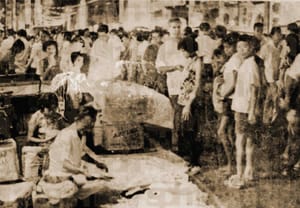
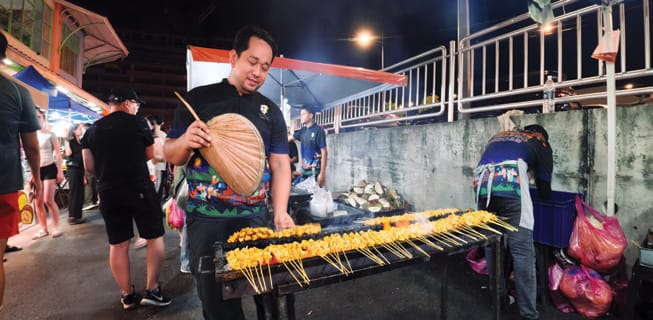
THE SATAY SMOKE reaches you before the stalls do: smell has never respected queueing etiquette. I had not been to a “pasar malam” (Malay for “night market”) for a long time, long enough that food trucks now outnumber the motorbikes of my childhood, when traders would arrive and unfold an ungodly amount of goods in what felt like seconds. The one at Tanjung Bungah has run every Tuesday night since around 1996; before that, it kept to the same weekly rhythm, a few streets over at Taman Concord.
The pasar malam embodies a contradiction. It has an air of both transience and permanence, of always having been there yet also not there, on account of this weekly cycle and its relatively recent institution. You would be forgiven for thinking that Penang’s pasar malam is a centuries-old tradition, but it is not. Its current form was actually a response to the federal govern-ment’s systematic winding-down of Penang’s free port status after the formation of Malaysia. This was an economic blow so severe that it forced the state into immediate reinvention, scrambling to find new reasons for people to continue visiting the former entrepôt. What emerged was a tradition that was renewed weekly: as much the-atre as marketplace, unmistakably Penang, and yet, like so much of Penang, adapted from elsewhere.
A TERM THAT GOT AROUND
The term “pasar malam” has spent most of its documented life meaning several rather different things. In 1853, a globetrotting German travel writer, Friedrich Gerstäcker, attended a Chinese “pasar malam” in Java, in what was then the Dutch East Indies (Indonesia today).[1] He described a theatre made of bamboo scaffolding, “looking like an overgrown rice hut”, “standing by itself, in the middle of the free and open market-place” and lit by coconut-oil lamps. The market had an air of festivity, with gongs sounding, children scrambling onto posts for a better view and a set of gam-bling tables leased, rather brazenly, from the colonial government. It appears to have been a traditional ko-kah-hì (高甲戲,“Chi-nese opera”, also known in Penang as Toa-hi, 大戲, “big show”) instead. Regard-less, this is one of the earliest documented mentions of the pasar malam.
The Dutch themselves, however, considered the term in relation to the fairs held before Muslim festivals. As an 1875 dictionary describes, it was a “nachtelijke markt, zijnde een Mahom. feest” (night market, being a Mohammedan festival). This was in reference to the Sekaten festival in Yogyakarta, a weeklong event of ceremony, festivities and pasar malam to commemorate the birth of Prophet Muhammad. By the 20th century, the term’s meaning shifted again. On 8 April 1910, the Singapore Free Press and Mercantile Advertiser used “pasar malam” to refer to an agricultural fair in Jambi, Sumatra, inviting curious visitors from Ipoh to admire rubber and padi cultivation developments.
However, according to Matthew Isaac Cohen, an expert on cultural heritage and Indonesian performing arts, the pasar malam “was not a Native form, but rather a Dutch transplant”. He argues that it was a descendant of the boerenkermis, the humble Dutch peasants’ fair, dressed up for the age of international exhibitions. It was institutionalised in 1904 with Batavia’s Pasar Gambir. One such fair was graced by the Sultan of Solo later that decade, who by all accounts was less taken with the batik and craftwork on display, than with a motorcycle stunt billed as “The Cage of Death”. He rewarded this performance with commendable generosity, presenting a gold watch each to the two riders.