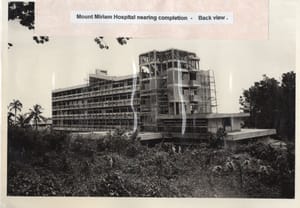
BEFORE PRIVATE HOSPITALS came to dominate Penang’s oncological scene, there was Mount Miriam Cancer Hospital. It served as the first and only charitable cancer hospital in the state and northern Malaysia, catering especially to the needy. In light of its recent in the state and northern Malaysia, catering especially to the needy. In light of its recent golden jubilee on 20 February 2026, the story of Mount Miriam is worth recounting.
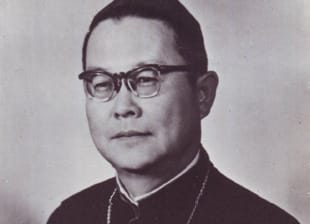
BISHOP FRANCIS CHAN’S DEFERRED DREAM
Mount Miriam’s establishment was envisioned by the Singapore-born Bishop Francis Chan Weng Cheong. Having been diagnosed with cancer in 1960 by a local doctor, Peter Tan Ewe Aik, Bishop Chan had to seek treatment in Hong Kong. This was because Penang had no treatment facilities or hospices for cancer patients, despite being a reputable provider of quality healthcare compared to most states in the Federation of Malaya.[1] Following a relapse which left him bedridden, Bishop Chan received personal care from the Sisters of the French Foreign Missions, known as the “Grey Sisters” because of the colour of their habits.[2] His personal experience ignited a strong desire to provide patients with a comparable high level of skilled palliative care, so that they could live their remaining time with dignity.
Assisted by the Grey Sisters and Tan, the bishop endorsed several fundraising campaigns for a cancer home. Not only did he donate $26,000 to the starting fund, but he also endowed a piece of church land along Kelawai Road for its establishment. Community support streamed in, including from Chief Minister Wong Pow Nee, a devout Catholic.[3] By January 1965, the Catholic community had successfully raised more than $7,000.[4] The Penang Rotary Club, Lions Club of George Town and Penang Junior Chamber of Commerce also contributed additional funds.[5] Unfortunately, Bishop Chan did not live to see his dream fulfilled. With $19,000 in additional funds received and construction plans awaiting the city council’s approval, he passed away in October 1967. [6] Shortly afterwards, another setback occurred when Tan was notified that the Grey Sisters’ work and stay permits would not be extended by the immigration authorities after 1975. [7]
THE NEW DAWN
Fortunately, Bishop Gregory Yong Sooi Ngean’s appointment in April 1968 ushered in a new dawn in the home’s progress.[8] He honoured his predecessor’s dream by offering a finer property on Bukit Padri in Tanjong Bungah. “Mariophile” (Latin for “Lover of Mary”) was a serene 30-acre plot, upon which sat a bungalow and chapel (See Pen-ang Monthly, December 2024).[9] Once a retreat for priests, it eventually housed what became known as Mount Miriam Cancer Hospital.[10] The Franciscan Missionaries of the Divine Motherhood (FMDM), who managed Singapore’s Mount Alvernia Hospital and Ipoh’s Our Lady’s Hospital, were invited to run Mount Miriam, and they proved “unanimously in favour of accepting this apostolic work”. [11]
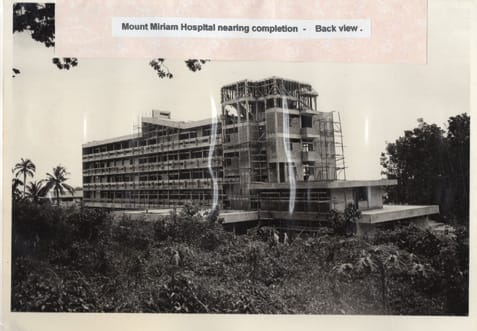
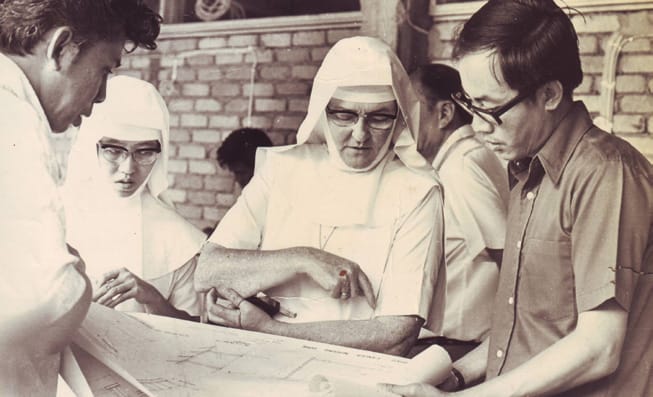
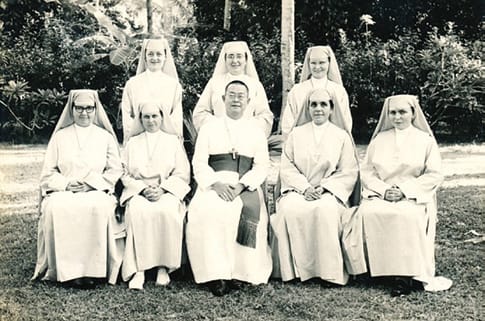
Led by Sister Mary Baptista Hennessy and her assistant, Sister Mary Raphael, were the “Magnificent Seven”: Sisters Assunta Low, Jennifer Chan, Jean-Ma-rie Andrews, Cyrilla Baptist, Caritas Gay, Christoforo Leo and Raphael McDowell. Like the late Bishop Chan, they proactively raised funds door-to-door, while those travelling north from Singapore collected funds along their journey. Given their existing reputation in Singapore, they even received a RM1mil donation from the businessman and philanthropist, Lee Kong Chian. Alongside Tan as well as the architects Derrick David and Dennis Liew, the nuns supervised Mount Miriam’s construction daily until its completion at a cost of RM2.5mil.[12]
Officiated by Bishop Yong on 21 Feb-ruary 1976, the 24-bed hospital opened its doors as a modest community home founded upon Catholic values and the spirit of St Francis of Assisi. Overseen by Tan, Mount Miriam served all patients regardless of race, creed and belief, while subsidizing fees and even providing free treatment. The “Magnificent Seven” ran the hospital almost single-handedly, performing roles ranging from administration and operations to housekeeping. Sister Cyrilla Baptist vividly recalled two of their first patients: the lift engineer’s mother with advanced fungating breast cancer, and a 10-year-old Malay boy with a large tumour arising from the orbit of his eye.
With no radiotherapy or chemotherapy available, they could only provide basic dressing, pain management and hygiene control.[13] But Mount Miriam also instilled an atmosphere of love and care for its patients. This required that staff respond to a special calling that radiated faith, hope and love despite the juxtaposition of hope-filled moments against bitter disappointment. Residing on the hospital grounds, the nuns set an example for the community to follow.
They not only nursed patients, but even remained present until their eventual deaths, ensuring that the last rites were safeguarded and families received emotional support.
TOWARDS PROVIDING ACTIVE TREATMENT
Coincidentally, Koh Pen Ting, president of the Penang Chinese Chamber of Commerce, was in attendance at Mount Miriam’s opening. Koh sought to admit his wife for treatment, but was unfortunately turned down because the hospital lacked treatment facilities. Consequently, he offered to raise funds for a Cobalt-60 radiotherapy machine.[14] In a special meeting at the Penang Rubber Association, attended by prominent local businessmen such as Tan Hoay Eam and Loh Boon Siew, RM480,000 was secured within an hour, thus paving Mount Miriam’s route towards providing active cancer treatment.[15]
With the machine’s installation in 1979, Mount Miriam grew into a leading oncological hospital boasting qualified radiotherapists and trained nurses.[16] However, it still remained a home where healing and comfort did not have to burden the needy. This ethos necessitated cost-effective measures, and the nuns proved extremely thrifty. They made their own disposable dressing and undertook cooking and laundry by themselves. Needlework to mend old sheets and covers was a common activity, and only those on the night shift had the luxury of a small desk light. [17]
These simple acts and the blessings of community support, as demonstrated in annual fundraising initiatives, sustained Mount Miriam’s operations despite rising costs. As the hospital expanded, medical operations were gradually taken over by professional staff while the nuns increasingly served as overseers, focusing on the provision of pastoral care to patients. Sister Jennifer Chan initiated the Clinical Pastoral Care Ministry in 1998 to provide counselling, emotional, spiritual and social support to patients, family members and staff alike.[18]
Care work paved the way for Mount Miriam’s evolution over 50 years by incorporating advanced, non-invasive and painless procedures, while returning to its roots in palliative care. As a testament to the importance of faith, human endeavour and public support, Mount Miriam continues its legacy as a charitable cancer hospital, bringing hope and love to the people who can least afford treatment.
ENDNOTES
- Peter Tan Ewe Aik (Dato’ Dr) and Eleanor Eu Gaik Choo. (2011). Prescriptions of Faith. Kee Koon Lay Sdn Bhd (p. 157); V. Thuraisingham. (2011). “Medical Rem-iniscences from 1960.” In Ong Hean Teik (ed.), To Heal the Sick: The Story of Healthcare and Doctors in Penang. Penang Medical Practitioners’ Society. (p. 91)
- An age-old affiliate of the Foreign Mission of Paris, which brought Roman Catholicism to Malaya around 200 years ago, the Grey Sisters arrived in Penang in 1954 to serve the College-General. Later, they opened a free clin-ic for the poor at No. 45, Perak Lane, in Jelutong. Known as the “Clinic of Our Lady of Lourdes”, Peter Tan served as its visiting doctor. See Tan and Eu (2011, pp. 155–57).
- The Straits Times. (1965, April 27). “Grey Sisters plan fund drive,” p. 7; Nanyang Siang Pau. (1967, October 24). “王保尼首席部長昨表示州政府將協助興建梹癌症病人看護 所呼吁公衆支持完成善舉’, 南洋商报,” p. 6.
- The Straits Budget. (1965, January 13). “$7,000 raised for Bishop Chan’s purse,” p. 20.
- Peter Tan Ewe Aik. (2001, February 11). History
of Mount Miriam Hospital [silver anniversary booklet]. Mount Miriam Hospital. (p. 2) - The Straits Budget. (1967, November 1). “Drive to set up cancer nursing home,” p. 7.
- Foreign missionaries, once quite freely allowed to enter the country before Malayan independence, would afterwards face greater restrictions. See Chew, Maureen K.C. (2016). History of the Catholic Church in the Diocese of Penang. The Titular Roman Catholic Bishop of Penang. (p. 71)
- The Straits Budget. (1968, May 8). “New Bishop of Penang receives good wishes – Dedicated to God and my fellow-men,” p. 5.
- Cheong, Paul. (1984). “The Historical Background of Mariophile.” The Seminarian: pp. 4–5.
- Letter from Mother Angela McBrien to Dr. Peter Tan, 31 August 1971, FMDM / D / MMCH / 1/ 1, FMDM Archives (Ladywell).
- Formed at Ladywell Convent in Surrey, England, in 1870 by a group of women inspired by the spirit of St Francis of Assisi, the FMDM sisters arrived in Singapore in 1949, having been invited by Archbishop Michel Olcomendy to work in his diocese. See: FMDM. (1999). Franciscan Missionaries of the Divine Motherhood
(FMDM): Golden Jubilee of Presence in Singapore & Malaysia: 1949–1999 handbook. (p. 19); Letter from Bishop Gregory Yong & Dr. Peter Tan to Rev. Mother General, 7 April 1970, p. 2, FMDM/D/MMCH/1/1, FMDM Archives; Letter from the Committee Secretary to the Committee advising that FMDM will take over the project, 27 April 1970, FMDM / D/ MMCH / 1 /1, FMDM Archives. - Tan (2001, pp. 3–4); Letter from Mother Angela McBrien.
- Interview by Dr Francis Tan with Sister Cyrilla Baptist, 9 December 2024, in Penang.
- Koh reached out to Mount Miriam Hospital through his son, Dr Koh Tsu Koon (then a lecturer at Universiti Sains Malaysia, later Penang’s chief minister). See: Zaatar, A. (2011). “Memories of Mount Miriam Hospital from 1976-2003,” in Ong (ed.), To Heal the Sick. Penang Medical Practitioners’ Society (pp. 87–88).
- Tan (2001, p. 4); Zaatar (2011, pp. 87–88).
- The introduction of locally taught nursing aides in 1977 saw Sister Cyrilla providing the team with in-house nursing training, according to a strict British-style timetable (inclusive of chapel time). Interview with Sister Cyrilla Baptist.
- Yuen, Priscilla. (2016). “Being the Pioneer Sisters,” Reflections: Mount Miriam Cancer Hospital 40th Anniver-sary, Issue 1. (p. 7)
- The Star. (2011, June 26). “Sisterhood of Caring Hearts,” p. 31.