
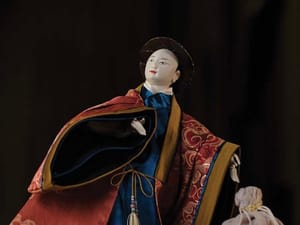
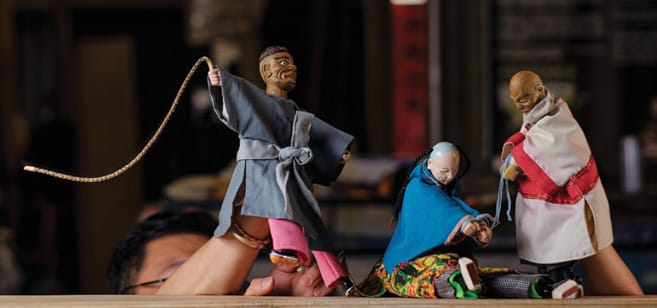
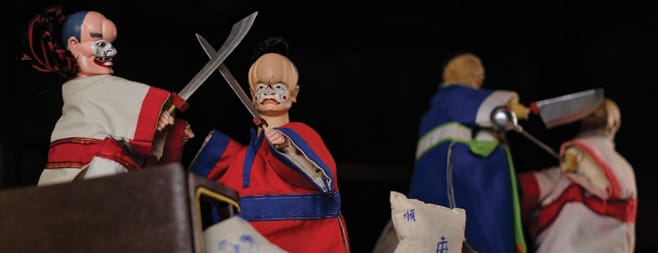
WHAT I HAVE always found magical about Potehi, or glove puppetry, is the amount of life that a once-inanimate object can be imbued with. When a few subtle twitches are accompanied by spirited voice acting, a character the size of your hand can be suddenly, and credibly, brought into existence.
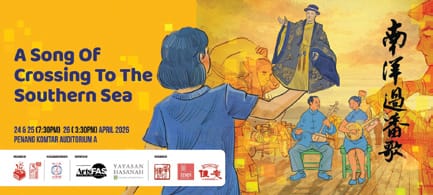
In some cases, the puppeteer and voice actor are not even the same person. Studying the programme book for A Song of Crossing to the Southern Sea, a recent Taiwanese–Malaysian collaboration, I was surprised to note that the two puppet protagonists were operated and voiced by different performers across scenes. I imagined a puppet behind the scenes, different hands slipping into its torso of cloth to give it solid shape, different throats modulating pitch and register, as if the character’s voice itself was a glove that could be put on and taken off at will. What unites the character, then, is the body of the puppet itself: the form which holds the substance.
The glove puppet fits perfectly onto a hand—its form is made for that function. But how does the form of glove puppetry fit the substance of the show?
COMPOSITION AND COLLABORATION
Song tells a straightforward story. In the late-Qing period, with war looming in the background, two young men from Zhang-zhou venture on a journey across the sea in search of new fortunes in new lands. It treads the familiar path of narratives concerning ancestral migration from Malaysian history. There are the requisite trials and tribulations, eventual financial successes and tragedies inseparable from the choice to leave one’s homeland.
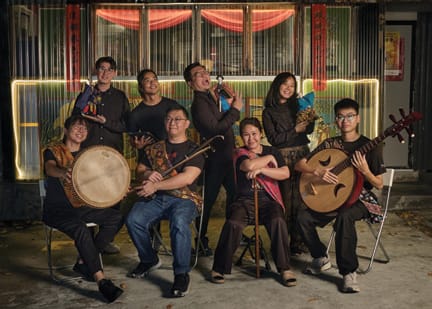
This journey is also expressed by a range of musical instruments and languages throughout the play. When the characters arrive in Malaya, we hear the strains of the seruling, and their spoken Hokkien gradually morphs into the Penang version we know today. Elsewhere, the anachronistic use of the guitar and cello captures the unreality of a hallucination sequence.
What is interesting is Song’s process of composition. The creators explained that in most cases, lyrics were drawn from existing songbooks and melodies borrowed from musical sets still circulating within traditional opera. It is a kind of patchwork process. In this way, the show establishes its intention of using the old to make the new.
Also new was the use of another art form, Liam Kua (lit. “chant-sing”), a blend of folk singing, dialogue and music, in this performance. Liam Kua becomes a storytelling device that operates on multiple levels. Performers serve as narrators who set the overarching mood and direction of a scene, but at points, they also chime in as characters themselves, crossing the boundary between story and narration. In this sense, they are similar to a chorus, both commenting on and participating in the story.