
WHAT HAPPENS WHEN you bring together two distinct Malaysian puppetry traditions? In December 2025, I participated in “Mai Cerita, Hidupkan Pentas Warisan”, a pair of workshops organised by Universiti Sains Malaysia (USM) students.
These on-campus events brought together Wayang Kulit (Malay shadow puppets) and Potehi (Chinese glove puppets) performances, not just as passive showcases, but as interactive sessions. “The Bayang Stories” and “Potehi: Stories in the Palm” involved participatory engagement, experienced through making and performing, thus demonstrating that Malaysia’s cultural eco-system is not composed of isolated silos, but is instead an interconnected cultural land-scape of shared multicultural identities.
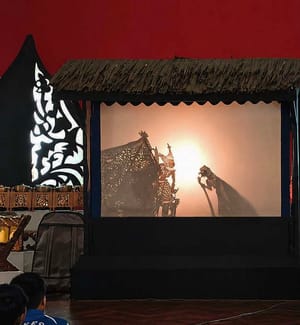
Relying on the interplay of light and shadow, Wayang Kulit captivates audiences through the moving shadows of puppets cast upon a screen, where epic tales woven into local folklore are narrated. Meanwhile, Potehi employs hand-manipulated, vibrantly crafted fabric glove figures to perform puppetry gestures on stage. While Wayang Kulit hides the master puppeteer, or tok dalang, behind the screen, the puppeteer (or at least their hand) is still visible in Potehi performances. Regardless, both forms share a common dramaturgical foundation in oral storytelling, rhythm, humour, moral reflection and communal gathering. By presenting Wayang Kulit and Potehi side by side, Mai Cerita demonstrates their differences, but also resonances.
FROM WAYANG KULIT TO POTEHI
Mai Cerita was conceived as a final-year project by a group of School of Communication students, which brought together not just members of the student body, but also secondary school participants from Sekolah Menengah Kebangsaan Raja Tun Uda (SMKRTU) and Penang Free School. Given the diminishing interest in traditional performing arts among youths, this proactive initiative was indeed an urgent intervention. “To sustain cultural continuity, younger generations must experience heritage, not just learn about it,” said Cheah Khe Xin, project director of Mai Cerita.
I started my immersion by attending “The Bayang Stories” workshop, held at Muz-ium & Galeri Tuanku Fauziah on 9 December, led by Mohd Jufry Yusoff from Wak Long Music & Art Centre and supported by USM’s cultural officer, Murshid Md Hussain. Mohd Jufry established the Centre in 2002 and is actively involved in traditional cultural performances (for example, Wayang Kulit, Gamelan and other folk music and dance performances). 47 participants were introduced to the world of the tok dalang, who narrates, manipulates and animates myth and moral tales through shadow and sound. The workshop concluded by inviting participants to craft their own puppets and tell new stories.
One participant from Penang Free School remarked: “Exposure to Wayang Kulit opens our eyes to the richness of our cultural heritage, something the younger generation should be proud of and treasure.” As their peer chimed in: “I look forward to more events like this. It widens my knowledge and cultural experience!”
On 15 December, Ombak Potehi 破浪布袋戲, led by Marcus Lim and Keith Song, conducted the “Potehi: Stories in the Palm” workshop. Ombak Potehi was one of the bodies established under the Ombak-Ombak ARTStudio in 2015 to promote art through performances, festivals, exhibitions and workshops.
Here, 42 participants were introduced to the basics of Potehi theatre, including the unique features of handcrafted glove puppets of varying designs, hand-warming exercises, puppet manipulation techniques, movement control and storytelling foundations. Traditionally associated with Hokkien communities, this palm-sized theatrical form is usually conducted in the community’s language. Participants were grouped together to practise hands-on puppet manipulation and movement control, before finally performing their own shows in their preferred languages. “I had never heard of Potehi or seen it before,” shared a student from SMKRTU. “This led us to discover Potehi.”
Participants happily left feedback on post-it notes, expressing satisfaction with their first-time experience, valuing their embodied and experiential learning. Through the curated activities held during both workshops, student participants shifted away from being merely observers towards becoming creators, narrators and performers in their own right.
REAL-WORLD CULTURAL WORK EXPERIENCE
Mai Cerita was envisioned as a celebration of the richness and layered diversity of Malaysia’s performance heritage, demonstrating how intercultural performance traditions can coexist as interconnected pedagogies that inform and enrich one another. This approach constructively fosters mutual understanding as well as a deeper connection to and appreciation for traditional cultural expression among younger generations. Ultimately, sustaining cultural heritage among communities depends not only on preservation, but also its continued relevance in contemporary life.
This project was organised by Hikarya, an initiative led by USM students, who collaborated on design, branding, promotion, reporting and, most importantly, execution. In short, they took ownership of the key elements of a real-world creative industry. From classroom learning to practising cultural agency, the Hikarya team worked intensely between October 2025 and January 2026 to conceptualise, pitch, fund, plan and ultimately conduct the project. Their strategic aim was not merely to foster pride in Malaysia’s multicultural traditions, but also to emphasise its continued relevance to society. Guided by their supervising lecturers, Mai Cerita also aligned with the United Nations’ Sustainable Development Goals, particularly the fourth and eleventh (Quality Education and Sustainable Cities and Communities, respectively).
Suriati Saad, the undergraduate programme chairperson at the School of Communication, stated that this inaugural final-year project format was intention-ally designed to mirror workplace realities. The goal was to expose students to the real industrial environment and, throughout the process, cultivate readiness to progress in their future careers. Although initiated as a graded academic requirement, in practice, it ended up as a full-fledged cultural production, where students collaborated across specialisations to support each other’s roles while networking with external stakeholders, building relationships that could lead to internships or even job opportunities.
Khe Xin and public relations lead Zetty Humairah were impressed by the team’s accomplishments throughout, whose responsibilities included developing social media campaigns on Instagram and Tik-Tok, creating booth displays, coordinating sponsorships, managing logistics, designing engagement activities and negotiating with artisans and cultural practitioners to schedule and curate learning sequences.
As Hikarya’s team navigated these industrial demands under a tight deadline, they confronted the creative, logistical and financial challenges of assembling cultural initiatives. They observed that preserving heritage demands more than just passion, but also effective strategic project management. Culture, in other words, is hard work.