
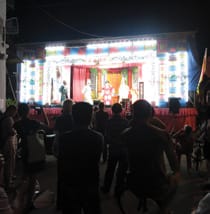
SINCE THE 1990S, demand for Chinese street opera has declined sharply from its heyday as both popular entertainment and part of everyday life. Still, whenever a deity’s birthday or the Hungry Ghost Festival is celebrated in Penang, temporary opera stages are erected, with troupes—whether Cantonese, Hokkien or Teochew variants—invited to perform for several consecutive days. But what did their early roots look like?
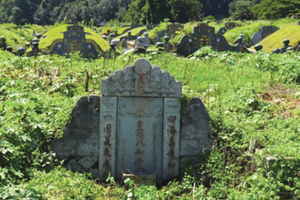
In 2024, I discovered two Qing-era common graves serving opera troupe practitioners at the Penang Kwangtung and Tengchow’s First Cemetery at Mount Erskine. Taken together, these offer clues into the lived worlds of these people, and the institutions to which they belonged.
OF NATIVE VILLAGES AND THE CHRYSANTHEMUM DEPARTMENT
The First Cemetery preserves 117 graves dating from the 19th century onwards, perhaps making it the Chinese cemetery with the highest density of common graves in Malaysia. At least 13 are related to specific occupational groups, covering the performing arts, services, retail, manufacturing and manual labour, among others. The guild organisations of barbers, Cantonese restaurant and cuisine practitioners, Hainanese kitchen workers, laundry workers, grocers, carpenters, cement workers and stonemasons also occupy space there.
The emergence of common graves should not be taken for granted. Early southbound migrants were often solo sojourners, many without family members or descendants locally. After death, their funerary arrangements were often handled by clan associations, guilds or native-place organisations. Chinese society generally believed that the dead required incense offerings, lest they became lonely wandering spirits. This belief in the immortality of the soul and the importance of honouring the dead led some organisations to gather unattended remains and rebury them in a common grave, where ritual offerings were made annually during the spring and autumn equinoxes.
The first “Common Grave of Pat Woh Tong of the Great Qing” (皇清八和堂總墳, coordinates 5.44283N, 100.3025E)—the earliest of its kind—was established in 1888 by Pat Woh Tong, a guild of Cantonese opera practitioners. This common grave, long-neglected and hidden behind overgrown grass, is made of finely carved white granite. Although modest in scale, its material, quality of carving, and calligraphy are exceptionally refined, demonstrating the importance that its founders attached to this burial and ritual space. The head of the tomb is decorated with a motif of the rising sun and drifting clouds, while two side pillars frame the main stele. These pillars are inscribed with the following couplet:
Lofty sentiments across the four seas are like those of one’s native village.
四海高情如梓里
A united spirit of righteousness moves the
world of the pear garden.
一團義氣感梨園
In contrasting “the four seas” with “one’s native village”, the grave discursively transforms fellow practitioners adrift in a foreign land into a community as close as kinfolk from the same hometown. Their “united spirit of righteousness” further highlights the bonds of fellowship and solidarity within the guild.
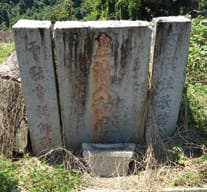
Coincidentally, about 190 metres uphill stands the second, identically named common grave (5.44341N, 100.30084E), similar in form but in poorer condition. It was erected in 1901 by the Lei Yuen Hong (Pear Garden Guild, 梨園行): an alternative name for the Pat Woh Tong, one which references the courtly entertainment institution of the Tang dynasty. Note that the “Lei Yuen Tong” (Pear Garden Hall, 梨園堂) was also used in some contexts. The slight difference lies in naming reflects a nuance. “Tong” suggests a hall, association or organised body, whereas “Hong” more commonly refers to the trade, profession or occupational line. In practice, however, the two terms were often used interchangeably in historical contexts.
Its tomb head has fallen off and the side pillars have slightly separated from the main stele. The couplet on the pillars, which makes historical allusions to the world of Chinese opera, turns the common grave into a site of ritual offering, remembrance, and the transmission of occupational spirit. It reads:
Through a hundred generations, strings and songs are passed down by the
Chrysanthemum Department [a traditional term for the Chinese opera world].
百代弦歌傳菊部
For a thousand autumns, offerings and sacrifices honour the Pear Garden.
千秋嘗祀仰梨園
WHAT WAS THE PAT WOH TONG?
Notably, there is no longer a Pat Woh Tong guild organisation in Penang, and clear historical records of its existence have yet to be found. Nevertheless, the common grave provides evidence that this occupational organisation already existed in Penang before 1888. According to tradition, the Xuanzong Emperor of the Tang instructed performers in singing, dancing and music in the Pear Garden, which became a general term for opera troupes and the theatrical world. Thus, opera performers were known as “disciples of the Pear Garden”.
The term “Pat Woh” itself (eight harmonies) originates from the eight divisions formed within opera troupes, divided according to duties and roles. These were the Siu Wo Tong (male-role actors), Hing Wo Tong (painted-face roles), Fuk Wo Tong (female-role actors), San Wo Tong (male and female clown roles), Wing Wo Tong (actors specialising in martial roles), Dak Wo Tong (supporting actors responsible for martial-action performances), San Wo Tong (administrative personnel respon-sible for arranging performances, signing contracts and collecting deposits), and Pou Wo Tong (musicians). Its name suggests the harmonious coexistence of these divisions, reflecting opera practitioners’ expectations in self-organisation.
Although the Penang Pat Woh Tong’s precise founding date remains unknown, we may infer some aspects of its history through the development of other Pat Woh associations. As early as the Wanli Emperor’s reign during the Ming Dynasty, Cantonese opera practitioners had already established the King Faa Wui Gun in Foshan. During the Taiping Rebellion in 1854, these performers responded in support of the uprising, and their association was subsequently banned by the Qing government. In 1857, the Pat Woh Wui Gun was founded in Singapore, and there is reason to believe that its founding was connected to the suppression of Cantonese opera organisations in Guangzhou. Being located in another Chinese-majority port city within the Straits Settlements, Penang’s organisation likely shared a similar background. Indeed, Penang not only hosted active commercial and migrant networks, but also mature performing arts organisations, occupational mutual-aid systems and ritual traditions.
During the Guangxu Emperor’s reign, the Pat Woh Wui Gun was revived in Guangzhou when the local prohibition on Cantonese opera was lifted. By 1889, the construction of its association building in Guangzhou was completed, one year after the first Pat Woh Tong common grave was founded in Penang. By contrast, the Pat Woh Wui Gun was only established in Hong Kong in 1953, while the Persatuan Pat Woh Malaysia was founded in Kuala Lumpur in 1968.
AN OPEN-AIR ARCHIVAL LESSON
Existing Chinese-language newspapers mention close relationships among the Pat Woh associations of Singapore, Hong Kong and Guangzhou. Now, traces of the Pat Woh Tong in 19th-century Penang are becoming more visible, gauging from these rediscovered common graves. They may allow us to rediscover a lost chapter of this Cantonese opera guild organisation.
These common graves remind us that a cemetery is not merely a place for burying the dead, but also an open-air historical archive. The performers of the Pear Garden, who once moved between opera stages, temple festivals and the streets of the city, may have long faded with time. Yet through these common graves, they have left behind traces of their presence, waiting for later generations to identify, write about and remember them once again.