
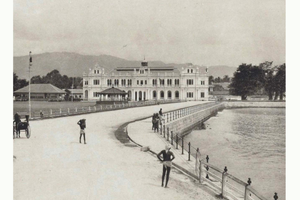
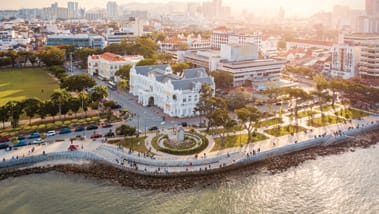
WHAT DOES AN award-winning heritage project look like in a city confronting climate change? In George Town, the answer is surprisingly ordinary: joggers at dusk, fishing lines cast from granite steps and families catching the sea breeze along a waterfront rebuilt to survive the century ahead. Here at the North Seafront, recent engineering works by public and private stakeholders have considered both climate action and community needs to engineer continuity, in line with coastal heritage.
HERITAGE AT THE WATER’S EDGE
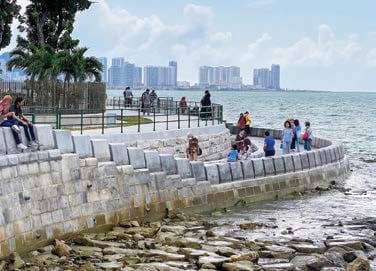
Standing on the granite edge of the North Seafront, the view stretches across the Strait of Malacca towards Gunung Jerai, where the Bujang Valley civilisation pre-dates the city by more than a thousand years. Long before Captain Francis Light founded a British settlement in 1786, these waters were already a global crossroads. This continuity becomes clearer when you understand what went into rebuilding the seawall.
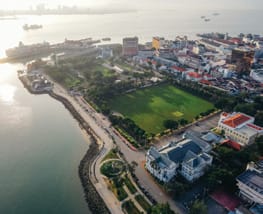
For more than two centuries, the Esplanade’s sea-wall protected George Town from the tidal forces of the Strait. Built of granite and laterite, it framed Fort Cornwallis, City Hall, Town Hall and the Padang: the civic heart of the city. Just as importantly, it gave locals somewhere to gather, catch the breeze and escape the dense inner city. Remarkably, as the decades turned to centuries, its core social function remained unchanged.
By the early 2000s, however, both the seawall and the spirit of the waterfront were deteriorating. A 2017 structural assessment found cavities, erosion, collapse zones, failed drainage and decades’ worth of ad hoc cement patching that obscured the seawall’s heritage character. Climate projections intensified the urgency of taking action: the tidal surges that had always threatened the shoreline were becoming more frequent and severe.
ENGINEERING AN HEIRLOOM
The decision to rebuild, rather than restore, was taken as conservation-led reinstatement rather than demolition. The new structure follows the original alignment, preserving the historic curvature of the coastline while replacing failing infrastructure with a granite-faced, mass gravity wall engineered for projected sea-level rise and stronger tidal conditions. Structural resilience became a form of heritage protection.
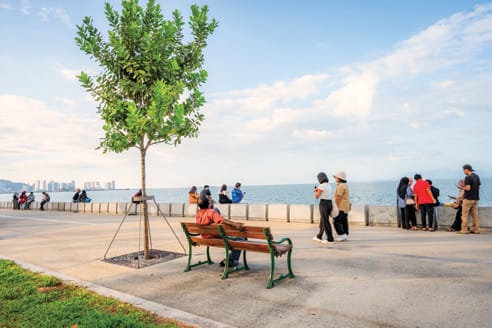
Reconstruction has also transformed how people use the waterfront. Offset seawards by five metres, the new wall has widened the promenade, now accommodating evening walkers who makan angin (“eat the breeze”, or in other words, enjoy themselves) alongside the recreational fishers who have cast lines from this shoreline for generations. It has catalysed a more vibrant nighttime atmosphere, with the emergence of pop-up vendors and increased activity around Medan Renong and the promenade.
Near the Cenotaph War Memorial, terraced steps were designed to tolerate periodic tidal submersion, allowing visitors to make direct contact with the sea and a restored section of the original 19th-century sea-wall, now framed for interpretation. Rather than resist-ing coastal cycles, the design adapts to them.
Attention to detail reinforced the project’s historical continuity. Memory tiles inscribed with archival accounts were embedded in the pavement, Penaga Laut trees were replanted along the promenade and local artisans contributed traditional masonry and metal-work.
The project itself became a collaborative exercise in conservation. Think City, working with the City Council of Penang Island (MBPP), Chief Minister Inc., George Town Conservation and Development Corporation and the Aga Khan Trust for Culture, coordinated the project, from structural assessment through completion. Collaboration among consultants and experts—including historians, marine engineers and archaeologists—strengthened both planning and implementation by ensuring that reconstruction responded sensitively to overlapping heritage, environmental and engineering challenges. Specialist craftsmen trained workers on-site in traditional stone masonry techniques that are growing increasingly rare within the heritage sector, thus ensuring the reconstruction built local skills and physical infrastructure alike.
Community engagement also shaped tangible outcomes throughout. Recreational fishing needs were incorporated into the design, veterans’ associations influenced the Cenotaph’s redesign and seafront hawkers were consulted during construction. The result was more than a rebuilt seawall. Indeed, it restored a civic routine central to George Town’s everyday life.
SUSTAINABILITY BEYOND THE WALL
Today, the North Seafront remains one of George Town’s most important public spaces, where joggers, fishers, families and tourists gather along the waterfront each evening. Post-construction surveys captured a perbezaan ketara (lit. marked difference) in visitor experiences and numbers compared with a decade ago, with visitation up by nearly 60%.
The seawall forms part of a broader North Seafront transformation guided by the George Town Strategic Master Plan. The programme has also reinstated the Fort Cornwallis moat, filled in around 1921 following a malaria outbreak, whose removal contributed to the Padang’s recurring flooding for almost a century (see Penang Monthly April 2021). It also restored the Koh Seang Tatt Fountain Garden and upgraded Lebuh Light, one of George Town’s oldest roads, as a pedestrian corridor reconnecting key civic landmarks.
Together, these projects demonstrate that heritage conservation and climate adaptation are not competing priorities, but complementary ones. The restored moat now functions simultaneously as stormwater infrastructure, an urban cooling system and biodiversity habitat. Reinstating it was not simply preservation, but the correction of an environmental mistake made a century earlier.
This integrated approach earned the North Sea-front transformation the award for New Design in Heritage Contexts and Special Recognition for Sustainable Development at the 2025 UNESCO Asia-Pacific Awards for Cultural Heritage Conservation. Prior to this, it received the Malaysian Landscape Architecture Awards Project of the Year, the Malaysian Construction Industry Excellence Awards Best Infrastructure and the Malaysian Institute of Planners Gold Award for Heritage and Conservation. Such recognition matters not because George Town gains yet another plaque or title, but because it acknowledges something increasingly important for historic cities worldwide: that resilience cannot be separated from public life, heritage and community identity.
George Town’s seawall protects more than the shoreline, it also preserves the city’s relationship with the sea and the civic life that has always gathered beside it. On this waterfront, continuity and adaptation are not opposing forces, but inseparable aspects of the city’s resilience.