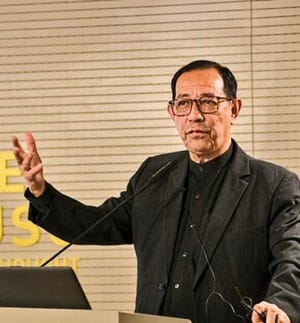
DZULKIFLI ABDUL RAZAK is the fifth recipient of the Dr. Wu Lien-Teh Society Award for Leadership in Public Health. He served as the Vice-chancellor of Universiti Sains Malaysia (USM) from 2000 to 2011 and was also the 14th President of the International Association of Universities (IAU) from 2012 to 2016. Today, he is the Rector of the International Islamic University Malaysia (IIUM).
Globally recognised for his expertise, he was appointed by the World Health Organisation (WHO) to serve on the WHO Scientific Advisory Committee on Tobacco Product Regulation and the WHO Expert Advisory Panel on Drug Policies and Management. He is the first Asian, and seventh internationally, to receive the prestigious 2017 Gilbert Medal from Universitas 21—a network of renowned research-intensive universities dedicated to fostering global citizenship and institutional innovation. He was also honoured with the 2017 Asia HRD Contribution to Society Award in recognition of his significant contributions to human capital development in the academic world.
Penang Monthly spoke with Dzulkifli just before his award presentation about his views on drug and vape handling, and also academia as a whole.
Rachel Yeoh (RY): First and foremost, thank you Tan Sri for sitting down for a chat with me. To begin, could you tell me a little bit about your background and how you got into pharmacy.
Dzulkifli Abdul Razak (DAR): My father is a Penangite and my mother is from KL. So I am half-lah. We were brought up in Tanjong[1] and my father is a survivor of the atomic bomb—a hibakusha.
I entered USM in 1971 to study pharmacy. We did not know what pharmacy was back then. And for that people called us farmers: P, H, A, M, E, R, S. Others thought it was “palmistry”—we read their palms and see whether they need to watch your luck. (laughs)
So we jumped into this thing, not knowing what it was all about. Suddenly, I found out that it was the worst, most corrupted industry in the world. Somebody gave me the book Roche vs. Adam: Adam was the manager of the vitamin section, and he wanted to make it more accessible to others. The company didn’t allow it. And finally, he was killed. I said to myself, “My God, this industry is a terrible industry.”
I began to look for alternatives. At that time, Anwar Fazal was the director at the International Organisation of Consumers Unions (IOCU), and he introduced me to S. M. Mohamed Idris, and I began to develop this whole idea of what I call “social pharmacy”. There was no such thing as “social pharmacy”—I was trying to address this whole social issue of what pharmacy does to ordinary people.
RY: How does social pharmacy change things?
DAR: Let’s say, an old man wants to buy a particular drug, and I push it to him at a 30% profit margin. He says, “I don’t have any money.” Now what do I do? I have to reject him, ask him to find an alternative.
We later learnt about essential drugs… generic drugs—all not part of the curriculum. We talked about regulatory functions and so forth, and we ended up doing a project, where people donated drugs to us, and then we dispensed these free of charge to people who could not afford them—free pharmacy.
But there was also a problem: if you provide free drugs, people do not want it. People think that it is a hopeless drug.
I was in Brunei with WHO. Brunei gives you the best proprietary drugs, right? But what we did every day at the end of the afternoon was, we had to go back to the waste paper basket and take all the drugs that were dispensed because they would be thrown away.
RY: Why?
DAR: People think free drugs are useless. They will go out and buy the same drugs at a high cost because “expensive drugs are good drugs”.
So the industry is made in such a way that branded, proprietary, expensive drugs are the most effective drugs. This is the mindset change that we need to talk about.
A friend of mine started a free clinic in Kelantan, but it is now closed because free medicine is “not good”. In pharmacy, I go for conferences, all paid for, first class and all… and all I need to do when I come back is to dispense your prescription. These are the kinds of corruption in the industry that academia does not care about. We are all sponsored by these people. We are happy when there is a crisis, because we can sell more drugs.
We developed a drug information system, where the information sourced could be found by people who needed it. In the early 1980s, there was a Loh See Fun poisoning that happened in Ipoh. About 100 people died and the doctors did not know what caused it. However, through this information system that we developed, we decided to test if it was boric acid, and voila, it was the problem! The manufacturer used access boric acid. Suddenly, we became nationally famous by providing a solution to the problem.
RY: Were you already part of the Poisons Board at the time?
DAR: I was, but the Poisons Board was more interested in medicine. This was more of a voluntary thing. It was only when we solved this particular issue that people started looking to us. We were a group of people with my students talking about pesticide poisoning and stuff—there was no official name.
For me, poisoning is dire because people die from it. So we worked hard on this, and they gave us the status of the National Poison Centre.
There was another episode where 25 drums of cyanide was dumped in Pangkor, and nobody knew what to do about it. They called us immediately. If that cyanide leaked, it was estimated that 7,000 people would die—immediately. That was another incident that put us on the pedestal. Our work became recognised by WHO.
After the National Poison Centre [was established] in 1995, I was asked to be the Vice-chancellor of USM. That was the year 2000. At that time, my idea of university also changed. I think the university needs to be a social enterprise, rather than what it is now, very academic, very detached from society… so we bid for that. There was a programme called APEX (Accelerated Pro-gram for Excellence).
I asked myself, “I am a Vice-chancellor in the year 2000 in the 21st century. How does university differ from the 20th century?” Everybody was talking about Y2K, except for universities. It was around that time that I was invited to a conference in Luxembourg called the University of Tomorrow. I met a consultant and futurist at the forum, named Sohail Inayatullah. I invited him to USM, and together, we were able to shape the future of USM in the year 2000 to the year 2025. There were six scenarios that we picked from many, and one of them was on sustainability. The word sustainability wasn’t popular then. Many asked me, “What is this sustainability?” But because the methodology is so rigorous, we were able to tell them exactly what it was. We were given the status of APEX University, with RM800mil in funding in 2008.
We are shaping the university now as education for sustainable development, which includes the community. So the trust is now in the community, and no longer the industry per se, and I think that is a shift from what the future of university would look like. That gave me a lot of leverage to bring in new ideas. USM became “University in a Garden”—I wanted it to be a metaphor: a garden has many types of plants, but underneath them are roots. Until you nurture the roots, you won’t get the plants. We do not want to just talk about what can be seen, the university rankings and so on. At the end of the day, most of the universities become irrelevant because the roots—the values—are not nurtured.
USM was picked as one of the seven pioneering universities on sustainable development, which was recognised by the United Nations.
I remember telling the minister, “Why can’t we take sustainability as a kind of a platform to build education?” He replied, “This one has no political mileage, so we are not going to bother.”
RY: Talking about political mileage, could you tell me about tobacco getting delisted from Malaysia’s poisons listing?
DAR: The model in the US is all about drugs—they have no tobacco problem. However, we have a tobacco problem. So we say tobacco is one subject that we do as far as poisoning is concerned. To be clear, we are not looking at the current consumers using tobacco, we are looking at schools.
We started a club, the “Nafas Baru” club (or the “Fresh Breath” club), to encourage students, through peer influence, to reject tobacco. We can’t begin this at age 30 because it will be too late, it is too difficult to change such habits. Currently, there is nothing to build that resistance. Then, there is the question of vape now. But the government is not doing anything about it, if at all.
RY: What can be done then?
DAR: The solution is staring at our face, but nobody wants to [implement it]. When vape was introduced, it was a substitute for tobacco. But it has become a gateway in, fuelled by highly addictive, chemically flavoured products. When we knew about this, we said we needed to ban it—that was in the year 2023. All the big medical health fraternities said the same. This is the part I’m very sore about, which I will not forgive the people involved. The Minister of Health at that time, Dr. Zaliha Mustafa, overturned it. They had a meeting on 31 March. She vetoed it. She said, “I use my mandate to veto this, because they want to implement this on 1 April—because the Minister of Finance will start taxing vapes on 1 April.” They want to make money out of this.
DAR: We’re off. Take the current Minister of Higher Education, he’s a political scientist. When he was appointed, I wrote a critical commentary. Unlike his predecessor, whom we successfully engaged on key university initiatives, this appointment felt driven by political ties rather than educational expertise. A top-down approach based on political proximity rather than merit inevitably stalls progress.
We need to have institutes like Penang Institute and associations like the Consumers Association of Penang to demand for what is right. In fact, this year, I was told every university is now given RM1mil to play the ranking game to be at the top 100—which is nonsensical to me. I was brought in by one private university to talk about ranking, knowing that I was against it. He said, “Look, Zul, we have got a problem.” I asked, “What’s the problem?” “Ranking. Now we are number 350 and this year we pay RM1.3mil to get the number. Next year (2018), if we want to retain this number. We have to pay RM2.5mil.” That alone will disqualify you from being a university. Then I asked, “Do your students know that you are paying for this number?” “They don’t. But as a private entity, we need to have this number or the public will think we are no good.”
RY: Similar to drug access.
DAR: Exactly. So, how to turn this around? Other countries are not as gullible as us. How many Nobel Laureates has Singapore produced? How many Nobel Laureates have the Japanese produced? In Tokyo alone, there are tens of them; yet Tokyo’s rankings are far below the National University of Singapore. What are we measuring? So these are issues that the academics are not bothered with, just like me when I went to pharmacy.
RY: At the expense of the younger generation.
DAR: They say, “Look, vape is safe”, but it is not. You can buy vapes anywhere. It’s not regulated. The money collected from taxing vapes will not be enough to rehabilitate one addict. Even WHO spoke to us and said, “Look, Malaysia will be the first country that will produce a new breed of addicts—vape addicts”.
RY: These are thought-provoking questions. I think that is all the time we have for now. Thanks for chatting with me.
DAR: Thanks for everything.
RY: You dealt with drug policies globally in WHO. Is there one thing that Malaysia—other than vape and tobacco—is currently ignoring?
DAR: I think Malaysia, from my point of view (and maybe I’m biased), we are very much industry-dependent. So, for example, with a drug, if it is registered overseas, then we quickly register it, whether we need to or not. It becomes an economic imperative rather than a health imperative.
I am asked “Why don’t you join the industry? You can make money.” But I cannot bring myself to. I can make RM40,000 a month at that time. But then my KPI would be, how many people do I kill a year? I cannot live with myself. Sorry to give you the bad story, but this is a struggle.
ENDNOTE
- George Town’s original name was Tanjong (or Tanjung Penaga): https://www. malaymail.com/news/malaysia/2024/07/24/george-town-or-tanjung-penaga-a-history-of-penangs-capital-and-a-call-to-restore-the-name/144381