
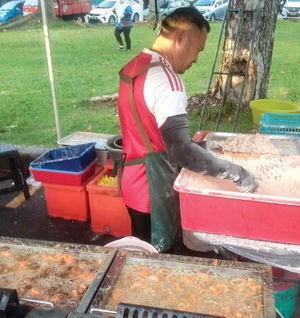
EVEN BY MID-AFTERNOON, there is still little to suggest that two ordinary streets in Taman Tun Sardon and Jalan Pantai Jerjak are about to become vibrant public spaces. But soon, vendors begin arriving and unloading crates of vegetables, sea-food and household goods. Within two hours, both streets transform into a bustling pasar malam (Malay for “night mar-ket”)—only to disappear without a trace by midnight. After spending an afternoon observing both markets, from setup to closing, I started thinking of them as temporary architecture: intangible urban spaces that exist not because of permanent structures, but through shared routines, coordinated movements and the collective rhythms of neighbourhood life. Heritage is often imagined as something preserved inside museums, archives or other formal spaces. Yet Penang’s many pasar malam remind us that some of our richest cultural heritage survives precisely because of its fleeting nature.
MAPPING THE RHYTHMS OF EVERYDAY HERITAGE
What fascinated me most was not the trad-ing activity, but the preceding transforma-tion and subsequent organisation. Before the first customer arrives, ordinary roads begin changing into commercial streets, pickup trucks become mobile shops and vans unfold into miniature warehouses. Nothing appears permanent, yet everything feels remarkably organised, down to the flow of the ensuing crowds despite the apparent congestion. Very little confusion occurs once the market begins operating. Customers instinctively slow down for elderly shoppers carrying groceries. Children dart between stalls while parents negotiate narrow passageways. Delivery trolleys pass quietly behind seafood counters, and neighbouring vendors occasionally help one another with unloading or packing. No one directs this movement. Yet hundreds of people continuously adjust their pace and position in response to everyone else. The market functions through unwritten coordination, forming a social choreography learned through habit, observation and mutual accommodation rather than formal rules.
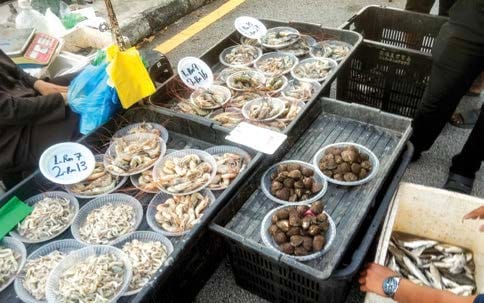
Both markets possess noticeably different personalities. Taman Tun Sardon retains the atmosphere of an established residential neighbourhood. Many shoppers appear to know the vendors personally. Purchases are often accompanied by conversations about family, work or local happenings. The market feels less like a commercial destination than a weekly gathering, where shopping becomes another way of maintaining community relationships. Elderly residents arrive early to buy fresh fish and vegetables, while familiar greetings travel easily from one stall to another. In contrast, Jalan Pantai Jerjak, surrounded by high-rise apartments and newer housing developments, attracts a more diverse mix of visitors, often strangers. Office workers stop by on their way home, university students arrive on motorcycles and young parents push strollers or carry children. Rather than serving a long-established community, this market temporarily brings together people whose daily lives rarely intersect.
In these ways, every pasar malam mirrors the social geography of the neighbourhood which it serves, becoming a living weekly map of the surrounding community. Every market, in turn, forms one node within a larger map of everyday Penang. In this sense, the vendors themselves create a form of social cartography.
TO EXIST IN TIME
Every vendor seems to know exactly where to park, how much space to occupy and when neighbouring traders will arrive. There are few instructions; their routines have been rehearsed weekly, sometimes for decades. The market exists only for a few hours, yet its temporary architecture is assembled with extraordinary efficiency.
This is what makes the pasar malam a temporal space. Its identity depends not on permanent structures, but on time itself. Remove the weekly rhythm, and the mar-ket ceases to exist. Watching both markets over the afternoon revealed a remarkably consistent temporal structure. The first phase is preparation, where wares are arranged carefully, sorted or hung up. As dusk approaches, daylight gradually transitions to rows of exposed lightbulbs suspended beneath canvas roofs. The changing nature of light signals the manifestation of the street into a market, where consumption becomes the major activity.
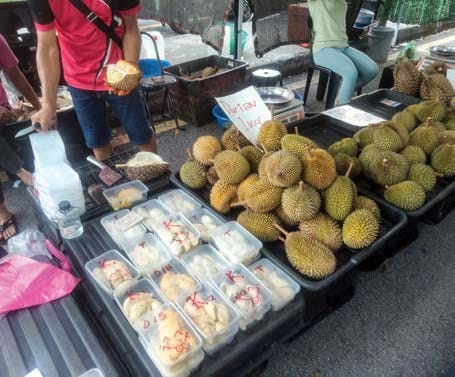
The customers change with the evening too. Older residents usually arrive earlier, hoping to purchase the freshest produce before larger crowds gather. Families appear around dinnertime, often combining grocery shopping with buying takeaway meals. Later in the evening, younger shoppers stroll more casually through the market, browsing clothing, snacks or seasonal fruits before returning home.