
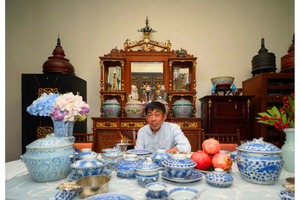
Walking Into Hotelier
Chris Ong’s home is like walking into one of his hotels. Lavish, opulent and ornate, it is reminiscent of an Edwardian Peranakan era. With its gilded doorframes, intricate wood carvings, mother-of-pearl rosewood chairs, teal and pink porcelain jars as well as gold-thread draperies, it is a maximalist’s dream. Ong’s journey as an antique collector began in his teens. Sparked by the desire to restore his grandmother’s cherished possessions, which were lost during the Second World War and between moving houses, the young Ong eventually ventured into antique shops and attended auctions to look for lost treasures. We dive into his efforts to keep Penang’s Peranakan Chinese material heritage alive, whether at home, in his hotels or through publications.
OF KAM CHENG AND TINGKAT
Growing up on Lebuh Muntri, Ong attended St Xavier’s Institution and subsequently moved to Melbourne for higher education. Throughout his time in Australia, Ong’s passion for heritage, beauty and restoration never left him. After 20 years in banking, a career shift to hospitality brought him to Sri Lanka, where he restored a 300-year-old colonial Dutch mansion into the Galle Fort Hotel.
Four years later, he moved home to George Town. “I came back to Penang in 2006 and became one of the earliest collectors of Peranakan antiques,” said Ong. The timing was serendipitous. In 2008, Penang received a joint UNESCO World Heritage Site inscription. That same year, Singapore’s Peranakan Museum opened with a huge collection of artefacts, some of which, to Ong’s chagrin, had come from many Penang families.