
“MY MEMORY BEGINS, as always,” opens When Memory Dies, “with the rain.”
A. Sivanandan’s 1997 novel follows Ceylon’s transition away from being an outpost of the British empire to the postcolonial state of Sri Lanka (where I was born). The novel is a rare charting of how centuries of exploiting Tamil workers on tea plantations paved the way for the state’s subsequent war on Tamil people.
This first scene unfolds in the 1930s, deep in the central highlands. A small boy watches the monsoon, nursing his own internal maelstrom: that morning, his best friend, the son of a plantation worker, was sent home from school because he did not have shoes. “The things that crowded in on me that day in the rain, and in many rains after, and made me an exile for the better part of my life,” reflects our narrator, looking back at his childhood self, “were also the things that connected me to my country and made me want to tell its story.”
Nearly a century after this scene, I convened a workshop at Hin Bus Depot in Penang to study this text. How does narrative connect land and water, nation and border? What is art’s relationship to empire and labour? What is the terrain of exile, and what are the responsibilities of the traveller and the storyteller?
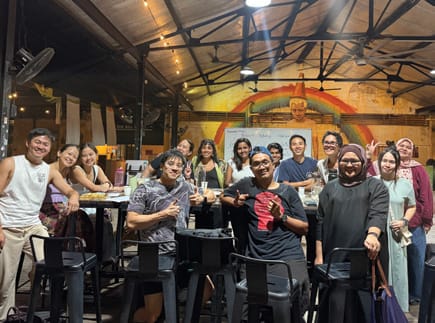
In homage to Penang’s linguistic multitudes, I designed the workshop as a collective translation exercise. From shop signs to street slang, Penang reverberates with many voices. To them all, we declared,
“ வணக்கம்” and “Selamat datang!”