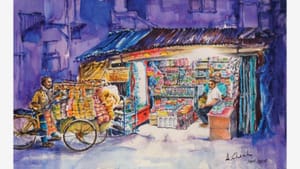
IN ANTHONY CHEAH’S watercolour painting, “Ottu Kadai Penang”, the small shop being depicted occupies hardly any space, yet seems to contain an entire neighbourhood. The term “ottu kadai”—also romanised as otthu kadai or oothu kadai—commonly describes a compact Indian sundry shop. Some occupy narrow roadside spaces, others lean against the sides of larger buildings. Their counters and shallow interiors bring trade directly to the pavement, where goods, conversations and neighbourhood knowledge circulate across their narrow thresholds.
THE SOCIAL LIFE OF THE OTTU KADAI
The ottu kadai is not a single type of business. Across my visits, I encountered sundry shops as well as small food-and-drink stalls sharing a similar spatial relationship with the street. Their trades differed, but each had a small frontage and was dependent upon repeated encounters and operators who knew the rhythms of their neighbourhood.
In Penang’s “Little India,” one proprietor showed me an old photograph of his father, who once ran a roti canai and bread stall directly opposite the present shop. This photograph connected two different businesses through one family’s continuing relationship with the same neighbourhood. He understood the ottu kadai as part of George Town’s distinctive heritage, rather than simply an old form of retail.
That sense of continuity is also visible within the wider trading landscape. Badan Warisan Malaysia describes Market Street as “Kadai Teru” (spelled “Theeru” in other contexts)—the street of shops—and identifies sundry shops, tea stalls and other traditional trades as characteristic of Little India.[1] Today, older trading forms continue to serve newer communities. The same proprietor estimated that around half his regular customers were migrant workers, including Nepalese and Bangladeshis, who came looking for familiar South Asian products.
At a food-and-drink stall on Lebuh Pasar, a third-generation operator pre-pared bubur kacang, cleaned the floor and arranged the seats by himself. Customers arrived to take away the dessert, some of whom were regulars. The stall is also known for chukku malli, an Indian herbal coffee. He estimated that about half his customers were foreign tourists and the other half local, a mix he attributed to being in Little India. The encounter was small but reveal-ing: continuity was not only about inher-iting premises, but also people returning.
Iksha Store, located beside Cititel on Jalan Penang, offers another perspective. Clean and with neatly arranged goods, it was among the few shops I visited that still sold newspapers and magazines. Eggs and daily necessities were common across the sundry shops, but the presence of periodicals made this one stand out. Traditional retail operations need not look cluttered or neglected to retain their distinctive service.
On Jalan Dato Keramat, I met a woman covering the counter of her father-in-law’s shop, while her husband’s family mourned the death of his grandmother. During the visit, a bread supplier arrived on his regular rounds; she explained that the family arranged for some of the bread to be sent to an orphanage. In that ordinary exchange, selling and giving briefly overlapped. The shop’s social role extended beyond the immediate transaction at the counter.
THE BUSINESS OF CONTINUITY
These visits revealed both vulnerability and persistence: relatives covering for an own-er’s absence, a third-generation proprietor serving returning customers, migrant workers supporting familiar products and a shop retaining its magazine display. The future of the ottu kadai cannot be reduced to a story of inevitable decline. The more useful question to ask is what continuity actually requires (see Penang Monthly, June 2026).
On licensing, several operators described their businesses as being reg-ulated within a similar municipal framework despite partaking in differing trades. However, they do not fall under one formal licence class because of their commercial diversity. The City Council of Penang Island (MBPP) distinguishes between trade and business licences, hawker and stall licences, private land stalls, temporary static hawk-ers and council market or stall sites.[2]
One Little India proprietor described his trading place as something that should remain within the family, rather than sim-ply be passed to an outsider. But inheriting the business depends on the shop’s licence or tenancy, where transfers are subject to MBPP’s approval. Succession is, thus, complex. A statement by a councillor said that transfer applications for such stalls may involve spouses, parents and biological siblings.[3] This procedure should not be as-sumed to automatically apply to every ottu kadai, but it shows why succession is an ad-ministrative as well as a familial question.
Ultimately, younger relatives should not be expected to preserve a business simply because others find it picturesque. Continuity requires earning a workable livelihood. Rent, licence conditions, suppliers, working hours and customer demand matter as much as signboards or shelves. Two operators told me that the local coun-cil had upgraded their flooring, suggesting that practical improvements can support everyday working conditions without turn-ing these businesses into something else.
My original question was whether these shops might disappear within five years. Perhaps not: instead, I found a form of neighbourhood commerce that persists by adapting to new migrant customers, tourists, changing products and the avail-ability of family members willing to take a turn behind the counter.
Paintings and family photographs can pre-serve appearances, but they cannot replace the everyday decisions that keep a shop meaningful to its community. If an ottu kadai closes, Penang may lose more than just another retailer. Another small piece of the distinctive way in which commerce, care and the street have learned to live together disappears.
FOOTNOTES
- Badan Warisan Malaysia. (2021, Apr. 6). Little India of Penang.
- MBPP. (n.d.). Jenis-jenis Lesen. [uLesen].
- Buletin Mutiara.
(2025, Aug. 27). Pindah milik gerai secara ‘online’, jangan bayar kepada
‘runner’ – Ahli MBPP.