“SEE?” says Tiger, dropping even more coffee inside his saucer and then lifting it and using it as a bowl to drink. “This is how we drink coffee when we think it’s too hot.”
The coffee is thick, almost liquor-like, and velvety on the tongue. It comes in vin-tage-looking cups adorned with flowers, filled to the brim and spilling over, turning the saucer into a dark swimming pool for microbes. On the table is a breakfast spread of dim sum, rice cakes and, obviously, a cup of local coffee from 118 Coffee Stall—it is as barebones and traditional as the old Rifle Range Market we are sitting in.
“When the Chinese here started to become the real crazy rich Asians, they wanted to follow Western trends. And of course, having seen many foreigners enjoy-ing their coffee, the Chinese wanted to try too.”
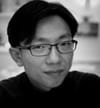
I am sitting in an old school food court covered by a metallic gable roof and lis-tening attentively to the charismatic Teoh Shan Tatt, better known as “Tiger”—he acquired this nickname partly because of his exuberance and partly because of his Chinese zodiac.
“You know, the Chinese never liked English coffee because it was too sour… that’s why they experimented with adjust-ing the flavour to their liking, and that’s how the Nanyang—which means South-east Asia—variety was born,” explains Tiger.
And because the Chinese were used to stir frying everything, they put coffee beans inside a wok and then added butter to them to make them smoother to fry. Nanyang coffee is traditionally made from Robusta beans grown in Java.
A little booklet Tiger handed out to us explains the differences between northern, central and southern coffee ordering methods—it is a dictionary of sorts. Flipping through it, I learn that even after 15 years in Penang, I didn’t know that ice cubes are served with hot coffee in the saucer to act as “aircond”—a way to cool down the brew without making it “kopi ais”.
The coffee experience that Tiger curates is part of a Penang Hidden Gems programme, and is part degustation, part ethnography and part family storytelling. He pairs Nanyang coffee’s curious history with an exploration of his neighbourhood—the Rifle Range flats, market and food court.
We met just half an hour earlier in Padang Tembak, or Rifle Range, an area sandwiched between the southeastern slopes of Penang Hill, adjacent to the more famous Air Itam. Tourist itineraries entirely overlook this area, but it holds great significance for Penang Island’s history.
“It still has a bad reputation because it was kind of a bad neighbourhood with gangsters, a bit like Hong Kong’s Kowloon,” says Tiger with a hint of pride, “but in fact, it was and still is a very tight-knit community here, where everything—even the cemetery—is in walking distance.” He points at a line of Chinese graves strung on the foot-hills next to the flats. “You can be born, live and die all within a few minutes’ walk,” says Tiger before cracking into a hearty laughter.
Shortly after Penang lost its free port status in 1967 and many jobs with it, the island entered a period of severe recession. The federal government then decided to mass build affordable housing units quickly and cheaply using a novel French prefabri-cated housing system imported by a German company, Hot Chief, which worked with a local company, Chee Seng. These affordable housing units were called the Rifle Range flats. The whole nine blocks were completed in less than three years using the current PBA (Penang Water Sup-ply Corporation) building as a factory for the production of building materials. Upon completion in 1969, the 17-storied flats were the tallest buildings in Malaysia.
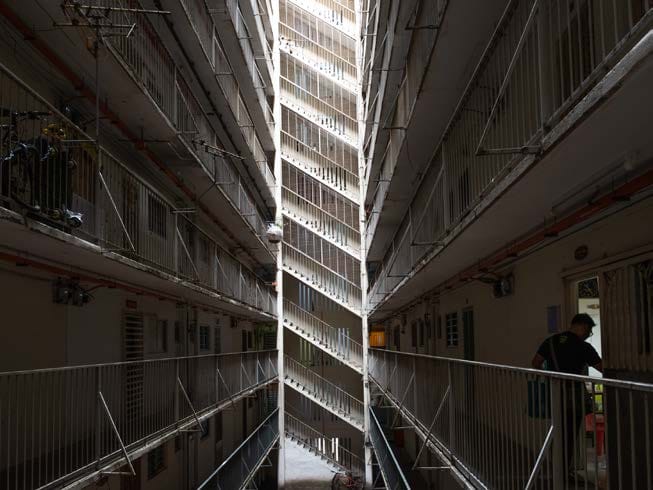
Tiger continues telling us stories as he takes us inside the Rifle Range flats. He shows us the iconic art-deco-like staircase between the rows of facing balconies as we go up the second floor. We enter a 300ft2 apartment that Tiger’s family owns and uses as a show-piece lab to explain and demonstrate how the roasting process begins—this forms the bulk of the experience.
This, Tiger clarifies, is a very different culture and process of making coffee that would probably make Melbourne’s Lygon Street baristas want to commit suicide—but again, the only science here is to make coffee the way Malaysians like it. This hap-pens by adding many unorthodox steps that entirely distort the taste of beans, which, remember, are necessarily unrefined.
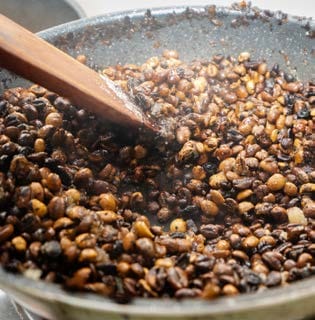
It’s our turn to learn the art of making Nanyang Coffee. Tiger puts butter, sugar and flaxseeds—not necessary, but good to make the beans taste nuttier—on the side, warms a deep frying pan and pours in half a kilo of beans.
“Stir up,” he says to me and a visitor from New York City before leaving us to spin the beans in a circle, always in the same direction. We add butter until it melts into a blackish sauce, then it gets absorbed into the beans, turning them sticky like molasses. After the coffee is roasted, we set it aside for a while, then smash it to smithereens with a hammer and grind it into the powder that will be brewed into coffee.
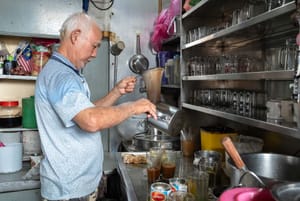
We are to bring our mixture to try and please Teoh Sing Kong, aka Ah Kwang or Pek Moh Kwang—Tiger’s father. Hailing from a family of coffee makers who began the trade by peddling kopi on the streets of Kuala Kurau in Perak, Ah Kwang has owned Kwang Coffee Stall since 1982. Kwang Coffee Stall sits right at the ground floor of the 3 Rifle Range’s block F and G, and is a rick-ety assemblage of metal tables, an awning and stacked furniture to hold cups and hot water tanks together.
When Ah Kwang tests our concoction while preparing some drinks, I must admit I am nervous, thinking I might fail. “Good job,” says Tiger as he serves us some cold hor ka sai, which means “tiger eats lion” in Hokkien (a misunderstanding of “you’re great” in Cantonese, he explains). It is a rich mix of Milo and Nanyang coffee. “Dad says you all passed.”
The knot in my stomach relaxes as the friendly Kwang comes over to serve us his special Deities Coffee—a mix of milk, coffee and barley that cannot be found anywhere else island-wide. With the master’s quiet approval, delivered in the form of this drink, I can almost believe I’ve learned to make kopi—or at least understand that in Malaysia, coffee is a simple pleasure, and no less delicious than coffee made anywhere else.