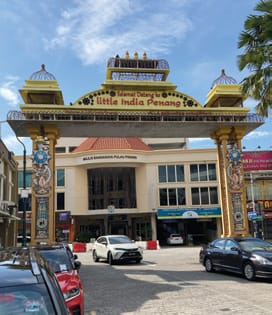
JUST PAST 8.30AM, I am hit by oppressive fumes of exhaust as the 101 pulls away from the “Little India” bus stop. The road gives off the distinct smell of pet-richor and wet tarmac. Apart from distant drumming somewhere down Lebuh Chulia, much of this side of George Town has yet to open. The underlying scent of the enclave could belong anywhere in the inner city: a general stale and musty amalgamation, with faint pigeon-heavy pockets disappearing and reappearing two doors down. It is against this stagnant unremarkability that everything else announces itself during a day’s walk through Little India.
FAITH AND KITCHENS
As I turn towards Lebuh King, I am overwhelmed by a comforting wave of spice scents. I find the bearer of this heavy nostalgia: Deen Claypot Briyani, which sits at the intersection with Chulia. Further down is the aroma of burnt sugar, buttery grease and the caramelised steam of teh tarik. Unlike the complexities of briyani, this scent is fiercely rustic, with undertones of dhal and tangy fish curry, drifting over a crowd of collared shirts and ties, sarongs and singlets.
Jostling against all these are the thick columns of smoke rising from large joss sticks outside the Tua Pek Kong temple, being burned for the Hungry Ghost Festival. There is no gentle way to say this: the smell of joss sticks wins out, and for a stretch of road, briyani, caramel and dhal all fall a step behind. It is barely 9am, and already, my sense of smell has encountered more than any one word can hold.
As I walk down Lebuh Penang, I am surprised by the gentler fragrance of pandan and coconut, as yellow trays of kuih are carried into Nyonya Palazzo. Closer to the intersection of Lebuh China, something earthier and faintly pungent surfaces. Diluted yellow patches stand out against the pavement and kaki lima (five-foot ways): water mixed with manjal (turmeric), cast across shopfronts each morning. 3A worker at a bridal boutique describes how “manjal is used to welcome pros-perity and protection so that no trouble or harm comes to the shop and those who work in it. It is also for those who enter the shop or walk past, so that they too will have a sense of calm and peace; a feeling that good things will come to them.”
While manjal is present in many other traditional and ceremonial practices, once scaled down to an everyday ritual, the practice remains private and collective; casting a blessing over the day’s business and everyone who crosses its path.
As more shutters are raised, trails of incense start to emerge. One is heavier, smokier and occasionally strong enough to blot out passing food smells entirely. The other is drier and sweeter, closer to a low, constant hum than a burst. Both are profoundly distinct; neither erases the other. Xiāng (Chinese joss sticks) offers a particular kind of reverence, rising from doorway shrines and the quiet thresholds of temples and kong-sis. Its heat is focused and patient, consuming tightly compressed botanical powder to leave behind a fragile spine of silvery ash. Its scent is lean, bittersweet and sharp, piercing the humid air with clarity. In contrast, agarbathi (Indian incense) is not always as visible, but its sultry, velvety aroma diffuses more evenly along the streets. At times, the deep, balsamic tones of resin and wood release something meditative and grounding. Other times, intoxicating florals like jasmine and frangipani cut brighter and sweeter. They are richer, rounder and often more pleasant, particularly around the more established goldsmiths and textile boutiques. These traces of Hindu, Taoist and Buddhist beliefs are evident throughout the day, sitting within the wider religious soundscape of Hindu devotional hymns, handbells, distant church bells and the muezzin’s call to prayer, which punctuate the passing hours.
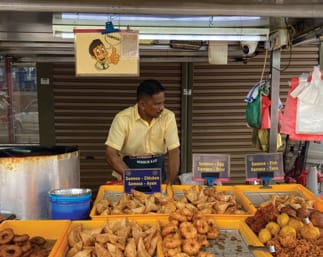
Food is perhaps one of the more immediate scents of Little India. A saturated, savoury atmosphere of generational recipes and secret ingredients simmering in large pots, interrupted by the sharper crackles of fried lentils, onions, batter and oil hitting the air. These are the louder smells of the street. 6 Then, there are quieter and sweeter undercurrents, like the perfumed nectar of ripened mangoes and the unmistakable roti bakar and kaya off Market Street, the latter crafted from a recipe preserved since the 1940s.

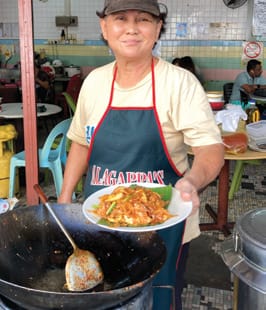
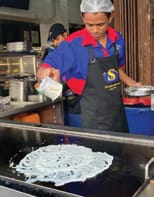
Two places particularly stand out. At the intersec-tion of Lebuh China and Lebuh Penang, cooking is a full-body experience. On one side is Hock Poh Lye Kopi-tiam, where a hawker works over a blackened cast-iron wok, shoulder-driving the metal against a high flame. Scorched soy and the sear of rendered fat rise: smoky, salty and slightly bitter at the edges. Directly oppo-site him, the motion is slower, lower and more deliberate: a hand smooths batter thinly across a flat cast-iron tawa, in three continuous circular sweeps. Ghee melts against hot iron, releasing a warm nuttiness as the bat-ter browns and crisps. Meanwhile on Lebuh Queen, nasi dalca announces itself and occasionally runs into an aromatic curtain from the Sri Mahamariamman Temple. Here, the smellscape shifts between the thick, hearty rempah of dalca and the density of brass oils and fresh jasmine garlands, blurring sustenance and sacred devotion.
THE BASE AND THE FOUNDATION
By afternoon, the crowd has thickened, and the streets smell more crowded too. It takes me a while to distinguish them, but there seems to be a layering of oils in the environment. Fleeting trails of sandalwood and frangipani, presumably oil-based perfumes worn by passersby, cut in and out of spiced and ghee-heavy curries and briyanis. Along certain street corners is the spitting heat of frying oil, while the medicinal sweetness of herbal and gingelly oils drifts from the open doorways of provision stores. Nearby, the subtle essential oils of raw spices and botanicals bleed from the spice markets, sweating in the humidity and after-noon heat. Beneath this, road and traffic smells persist. The drains are more pronounced now, smelling damp, pungent and slightly sour, although the stronger smells of lunchtime are usually enough to cover them.
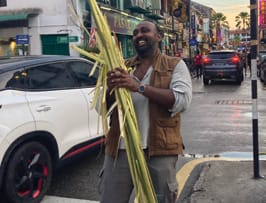
Later that evening, I am back along Lebuh Penang, when I come across whole stalks of sugarcane stacked in bundles by the pavement. Their smell is subtle—green, grassy and freshly vegetal—although perhaps my familiarity with them amplifies what I can other-wise only see. They are sold by Anbukarasan Moroter, a director, actor and writer who also trades seasonally, this time for Ganesh Chaturthi. The sugarcane stalks are one of the more transient, festival-bound scents of Lebuh Penang; with the arrival of Deepavali, Ponggal or Thaipusam, the smellscape shifts again. As I chat with Moroter, a thick, soft cloud rises behind me, and the pillowy scents of steamed rice, jaggery and coconut take over, as kolukattai and puttu are packed for a growing line.
As I step into SAG PG Enterprise along Lebuh Pasar, the smells are nearly indistinguishable. Underlying a heavy, earth-toned foundation are hints of ground roots, forming the base of nourishing meals and drinks shared across the enclave’s diverse communities. A closer sniff gives me the liquorice like note of cumin and fennel from India and Egypt, colliding with Indonesian cinnamon and nose-tickling peppers from Vietnam and Sarawak. The shop’s owner, Abdul Malik M. Abdul Gaffar, knows the supply routes well. He keeps track of markets, origins and the consistency of each shipment, checking what is available and where it comes from. 11 Since the Covid-19 pandemic, the market has shifted. Regular customers remain, but restaurants and larger orders for kenduri, weddings and festivals have since become an important part of his business. Such spice shops sit at the crossroads of international trade routes and networks.
The goldsmiths and jewellery shops offer a curious break. Inside, the air is chilled, sterile and scentless. Cooled down by air-conditioning, external scents are kept at bay, while internal fragrances remain delicate yet rich. Textile shops, on the other hand, have a distinctly dry, slightly starchy and faintly chemical note. I am told that it is the aftermath of starch, commonly used in cotton textile production to strengthen yarns during weaving, which can also contribute to the stiffness of finished fabrics. It is difficult to separate the smell of finished material from the processes that made it.
Between the scents of the everyday and the transient, I am made aware that Little India holds many worlds at once. They are an invitation to return to kitchens, devotion, homes and celebrations; containers of fragments of childhood, family, culture, religion and tradition; recognised differently by everyone passing through. Perhaps that is what an openness towards smells offers: a way of experiencing a place beyond simply what we see.
Try it yourself!
Little India smells different to every-one who walks through it. We would like to know your experience! Scan this QR code to add your observations of its shifting smellscape to the Urban Poli-phonies project. This activity takes about 45–60 min-utes to complete on foot: simply note what you smell, where you are and the time of day.