
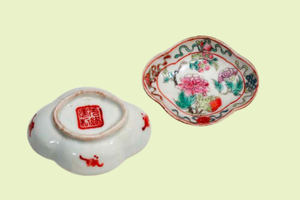
TUCKED AWAY IN cupboards, largely forgotten by younger generations, collections of Peranakan Chinese porcelain (or Nyonya ware)—including plates, dessert bowls, dishes, teacups, spoons and spoon rests—still have plenty to say. Resplendent in vibrant colours and auspicious symbols, these deserve to be brought into the spotlight. Some items from a collection belonging to my late husband, a Penang Baba who migrated to Australia, offer a good starting place for exploration. Through careful observations and wide readings, the stories contained within these ceramics emerge, akin to reading a text. What are the provenance and cultural significance of these artifacts, and what can this collection tell us about their cultural roots?
SYMBOLS AND THEIR RICHNESS OF MEANING
Peranakan porcelain was produced for the Chinese community in the Straits Settlements, circa the 1800s to mid-1900s. This community commissioned ceramic ware via traders dealing in commodities such as tin and rubber, who acted as middlemen by placing orders at the kilns in Jingdezhen, in northeast Jiangxi province. Famous for its unique kaolin, Jingdezhen was known as the porcelain capital of China, having produced and exported Chinese ceramics for at least a millennium.
Coming to these items with a Westerner’s eye and sensibility meant that I had much research to do. See-ing how my husband valued and cared for his collection, it was obvious that these objects held a special place in cultural memory. Indeed, the highly structured designs tied the Peranakan Chinese firmly to their ethnic heritage. As such, understanding the symbolism of the resulting Nyonya ware is like cracking a secret code.
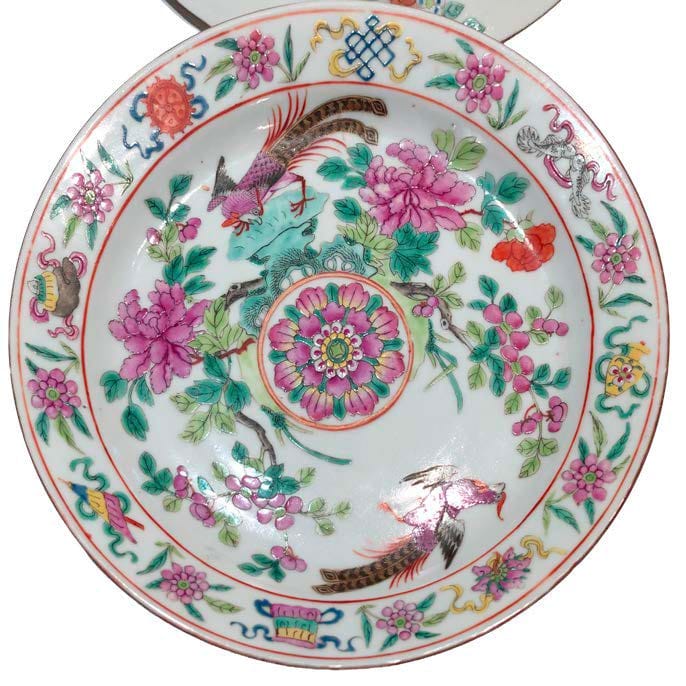
Image 1 shows both the obverse and reverse faces of two 22cm-diameter serving plates, each with sloping sides, shallow centres and short footrings. A fine, if typical, example of Nyonya ware, their tightly packed floral and bird motifs, among other auspicious forms, come in bright, vibrant colours. A stylised chrysanthemum—which is considered to be one of the Four Noble Plants and symbol of longevity, steadfast friendship and intellectual pursuits—rests at the centre, while the phoenix and peony, two leitmotifs of Peranakan iconography, occupy the middle space.