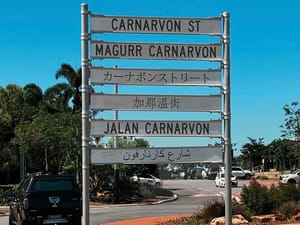
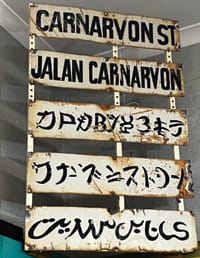
DURING MY VISIT to the Broome Historical Museum to learn about its pearling industry, my attention was drawn towards an historic street sign on display. Immediately, I felt like I was in Penang, judging from the multilingual listings of the street name—Carnarvon—in Malay, Arabic, English, Japanese and an Indian script. But Broome is a remote town on the far northwest coast of Western Australia, sitting between the blue turquoise waters of the Indian Ocean and the red dirt of the Kimberley region. It functions as an important regional hub with a fly-in, fly-out workforce servicing the mining, oil and gas industries. Traditional tourism and the pearling sector round off the major attractions of this still-remote outpost, whose transnational history of pearling prompted my journey. Along the way, other links to Penang’s part of the world came into view.
THE LURE OF PEARL SHELLS
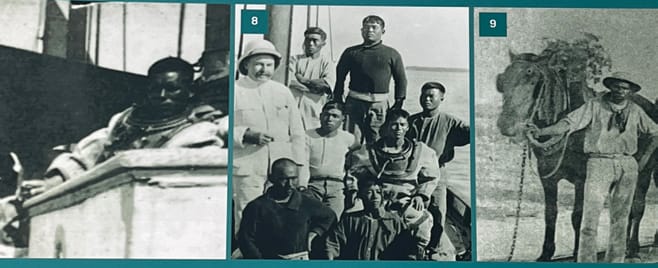
Over a century ago, Broome was home to one of the world’s largest pearling fleets, responsible for more than a quarter of the global supply of high-quality mother-of-pearl shell. Its iridescent lustre has had a universal appeal across history. Pearlers in the late-19th and early-20th centuries harvested mother-of-pearl shell, which was used to create pearl shell buttons (used before plastic buttons were invented), buckles and ornamental items.