
HOW CAN ONE curate anything in the absence of an institution? Without a building, staff or funding—without a space to hold what is often already fleeting—what can an independent curator do?
When I left the structure that once defined my daily work, I found myself liv-ing by the sea. In moving homes, shifting routines and embracing a structure-free life, the beach became my open studio. As I walked along the shore, observing tour-ists, children and horses treading the long stretch of sand, I began to wonder how one might continue to curate without the safety of infrastructure and other people. The sen-sation of grit between my toes reminded me that grounding could come from movement itself.
University of the Arts Singapore. Later, it found its grounding in the Philippines with the Cultural Centre of the Philippines as an organising partner. Finally, in its conclud-ing phase, it was held in Malaysia towards the end of 2025, in collaboration with the George Town Literary Festival (GTLF) and Penang Art District (PAD).
The project unfolded like a series of crossings—between places and artistic and cultural sensibilities. It became a way of working that was nomadic, not only in geography, but also in thought: echoing my own curatorial practice, intertwined with my personal reality.
In Singapore, the monumental architecture of the University of the Arts shaped the conditions of presentation. The works of the Danish artists, Lilibeth Cuenca Ras-mussen, Molly Haslund and Sophie Dupont, engaged with the reflective surfaces of the built environment and its institutional framework.
The Philippines demanded a different kind of listening. There, In Situ spanned over 700km, from the mountainous terrains of Mount Makiling to the shorelines of La Union and the dense urban zones of Manila. The heat, the humidity, the unpredictable weather—each became part of the choreography.
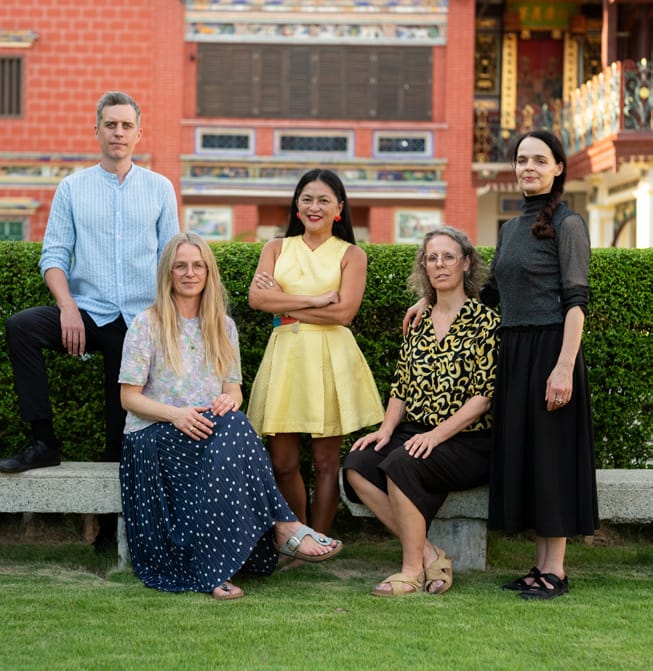
In Situ reached Malaysia in November of last year, finding itself in yet another state of becoming—less a repetition, more an act of reimagining what an institution could be. Penang’s colonial façades, clan association temples (kongsi) and a repurposed transport hub offered a textured map of possibility. I collaborated with arartists-ists and partners to transform cultural and public spaces into vibrant stages.
This Penang edition introduced a hybrid model, merging the ephemerality of live performance with the persistence of exhibition-making. Working again with Molly Haslund, the only artist present in all three editions, we explored once more how meaning shifts when a performance travels across time and space. Her work, Teenagers Eating Ice Cream Cones, was staged at Hin Bus Depot, offering its own atmosphere, audience and temporal rhythm.
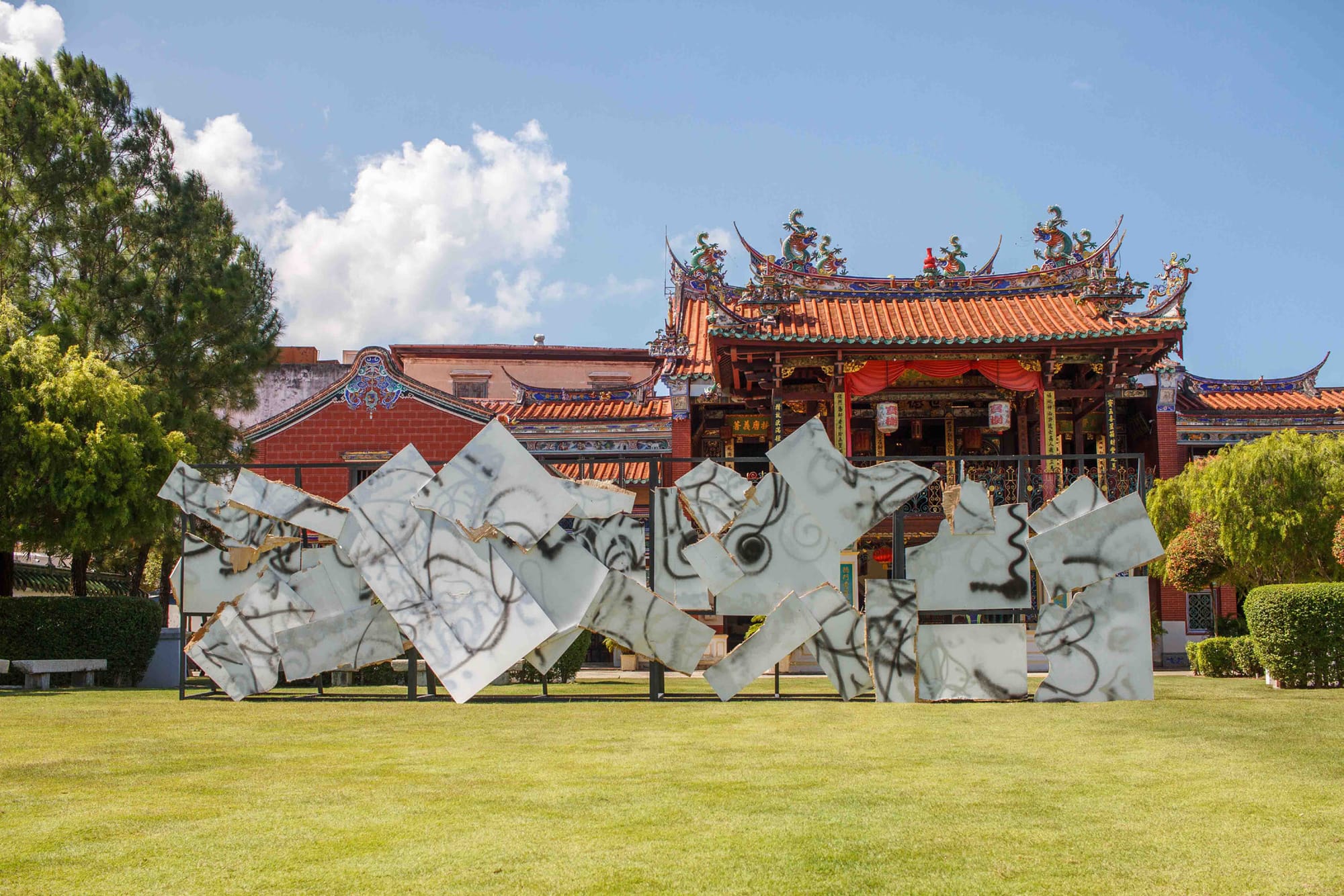
Christian Falsnaes’s Front, presented at Cheah Kongsi for the final act of the GTLF, was part of a series of works in which the artist explores the creation of artworks as a collective rather than an individual process. At this site, he allowed the audience to become part of the work; the resulting piece related directly to their situation instead of to his as an artist. The work began with a blank white wall—a metaphorical starting point representing existing structures that can be dismantled to make space for something new. The artist guided participants to
After years of orchestrating large-scale participatory and immersive projects within a museum, I had grown accustomed to the noise of production: the endless calls, negotiations, approvals and the cycle of conceiving, managing and installing. Then, suddenly, there was nothing of it, only questions and a silence that produced a different kind of sound: a hum of possibilities.
In that silence, new ideas emerged. I realised that the work could start precisely from this absence, from a place where structure is not provided, but created.
Performance offered that opening. In conversations with artists whose practices dwell in gesture and presence—those who can transform the ordinary through movement, breath or gaze—I began to reimagine the curator’s role.
These artists, through their own precarity, embodied a way of making visible what resists permanence. Their capacity to activate space through the body suggested a way forward—curating as an act of attention, of framing the ephemeral without freezing it.
This impulse became the seed of In Situ, Performance as Exhibition. It was not conceived in an office or an institution, but rather during walks, conversations and moments of uncertainty. The first iteration took root in Singapore through collaboration with LASALLE College of the Arts, engage with the structure in their own way, yet ultimately towards a shared objective.
Without their active collaboration, the work could not have existed.
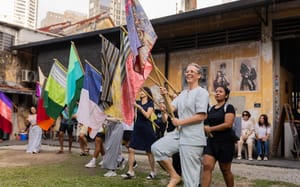
Hesselholdt & Mejlvang, whose practice centres on participation, activated audiences through textiles. People contributed personal fabrics at a COEX work-shop, each carrying its own memories and stories. These textiles were transformed into large-scale banners for a participatory performance at Hin Bus Depot and an exhibition at ChinaHouse. Through movement, music and collective action, the work celebrated diversity, communal identity and the creative energy that emerges when people come together to co-create.
Across these sites in Penang, the artists’ work activated audiences as co-creators, revealing the city itself as a stage. By situating performances within the rhythms of daily life, the Malaysian edition of In Situ blurred the distinctions between art, com-munity and site. Culture here was not held within walls, but carried through encounters—improvised, porous and communal. Each site became a living stage where meaning was co-authored and ephemeral, emerging in the shared presence of artist, audience and space.
When combined with exhibition elements, these gestures allowed performances to linger, existing both in the moment and as traces within a broader archive. This hybrid approach affirms In Situ’s underlying principle—what disappears can still leave resonance, and the invisible can pulse with presence.
What happens after a performance ends? The answer is not in the image or the document, but in the body that re-members—the spectator who carries the vibration forward. Each gesture reconfigures space, reshapes time and reorients perception.
encounter rather than display, continuity rather than collection.
Curating without an institution is not an act of lack, but of invention. It calls for imagining new architectures of connection, for believing that even without walls we can build worlds—momentary, porous and alive. This is the space where my spirit moves.
Curating becomes an act of care: attending to what vanishes, framing what resists possession. It demands patience, humility and a willingness to dwell in uncertainty. It is about creating spaces of encounter rather than display, continuity rather than collection.
Curating without an institution is not an act of lack, but of invention. It calls for imagining new architectures of connection, for believing that even without walls we can build worlds—momentary, porous and alive. This is the space where my spirit moves.