
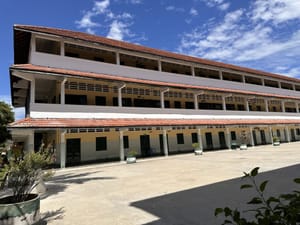
THE ENROLMENT RATE among Penang’s public high schools is declining,[1] but not in St. Xavier’s Institution (SXI)— the second-oldest school in Malaysia as well as the first Lasallian institution based in Asia. Walking down its bustling corridors one Friday morning, I was greeted by students in brightly coloured co-curricular attires, who smiled as they headed towards the canteen. I was there to talk to brother-director, Jason Blaikie, and board of governors’ chairman, Victor Tan, about what it was that kept SXI afloat. From these interactions, I gained the sense that the answer involved something intrinsic to the culture of this 172-year-old institution.
How SXI Keeps Enrolment High
by
Justin Teoh
Previous Post

Next Post
Addressing PISA Disparities to Propel Penang’s Semiconductor Industry
5 min read
WITH THE SWIFT beauty of mother earth. evolution in communication technology, it becomes increasingly crucial for a country like Malaysia…

You might also like
Penang’s Pasar Malam: The Rhythm Of Community And Local Business
10 min read
ASIA’S NIGHT MARKETS, or “pasar malam”, as they are called in Malaysia, are a popular and established form of…



Photographing The “Dying Trades” of George Town
5 min read
I WAS FLÂNEURING among artisanal traders along the streets and alleys of George Town in 1996, with a Leica R…