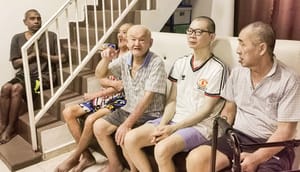
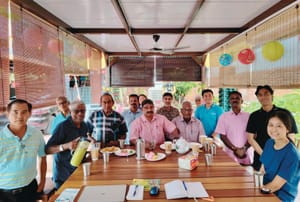
Gender-segregated homes for Penang’s elderly poor reveal a quieter reality of ageing—where care is shaped by constraint, vulnerability and cultural unease. Beyond shelter and survival, they expose how loneliness, dignity and intimacy persist even at life’s margins, often unspoken but deeply present.
Germany’s renewed push into Penang signals shifting semiconductor supply chains. For Malaysia, the opportunity is clear—but so is the risk: without moving up the value chain, it may remain a hub for labour and assembly, not innovation.
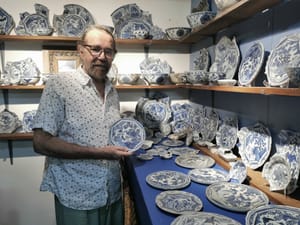
In the space Rongen has curated over two decades, ceramic shards from the Wan Li shipwreck are arranged like relics. Some have been made into jewellery and others set onto small sculptural pieces. The rest remain untouched, displayed just as they were when they were lifted off the seabed.
From the home or hospital where death is certified, the mosque where prayers are led, to the burial ground and the gravestone where names are carved into, each pair of hands carries the deceased a little further along their final journey.
Spearheaded by Arts-ED, a Penang-based arts and education non-profit, this participatory mapping project places local voices at the centre of heritage documentation—literally putting them on the map.
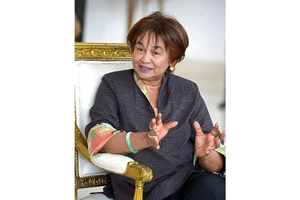
One can only imagine the lonely path Siti Zuraina Abdul Majid has travelled as Malaysia’s first archaeologist, and one with considerable academic gravitas under her belt. A returning graduate from the UK, she was only 24 years old when she excavated her first site in the late 1960s.
An Honorary Consul-General of Pakistan in Penang since 2007, Abdul Rafique Karim attends to the needs of the Pakistani community who reside in Penang. He himself is a fourth-generation naturalised Malaysian of Pakistani descent from Punjab.
Ooi Kee Beng, a prolific writer and academic, continues to shape discourse through Penang Monthly, Penang Institute, and his regular column in The Edge.